







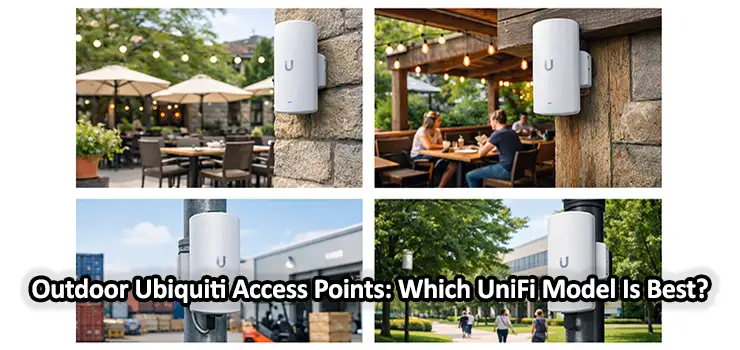
Outdoor wireless coverage has become a core requirement for modern businesses, residential compounds, hospitality venues, warehouses, and even small ISPs. From open parking areas and courtyards to industrial yards and outdoor cafés, stable Wi-Fi is no longer optional. This is where Outdoor Ubiquiti Access Points stand out. Designed to deliver consistent performance in challenging environments, UniFi outdoor models combine enterprise-grade hardware with centralized management and long-term reliability.
Choosing the right model, however, is not always straightforward. UniFi offers multiple outdoor access points with different antenna patterns, weather ratings, radio capabilities, and use cases. In this in-depth guide, we will explore Outdoor Ubiquiti Access Points in detail, explain how UniFi outdoor models differ from one another, and help you determine which option best fits your real-world deployment.
Understanding Outdoor Ubiquiti Access Points and UniFi Design Philosophy
Outdoor Ubiquiti Access Points are built around a simple but powerful concept: enterprise wireless technology that remains affordable, scalable, and centrally manageable. Unlike many consumer outdoor routers, UniFi access points are part of a unified ecosystem managed through the UniFi Network Controller. This controller allows administrators to configure, monitor, and optimize wireless performance across multiple locations from a single dashboard.
What makes Outdoor Ubiquiti Access Points particularly attractive is their balance between hardware robustness and software intelligence. UniFi outdoor devices are typically enclosed in weather-resistant housings, support PoE for simplified installation, and are designed to operate continuously in high-temperature and high-humidity conditions. At the same time, they integrate advanced features such as fast roaming, band steering, airtime fairness, and detailed RF analytics.
Ubiquiti has positioned UniFi as a long-term infrastructure solution rather than a short-term consumer product. This approach is especially relevant outdoors, where installation costs are higher and replacing equipment frequently is impractical.

Why Outdoor Wi-Fi Requires Specialized Access Points
Outdoor wireless environments behave very differently from indoor ones. Walls, ceilings, and controlled layouts are replaced by open spaces, reflective surfaces, weather exposure, and unpredictable client density. Outdoor Ubiquiti Access Points are designed specifically to address these challenges.
Weather resistance is the most obvious factor. Rain, dust, UV exposure, and temperature fluctuations can quickly degrade standard indoor hardware. UniFi outdoor models use sealed enclosures, industrial-grade components, and corrosion-resistant materials to ensure stable operation over time.
Radio behavior is another critical aspect. Outdoor coverage often requires carefully tuned antenna patterns to avoid wasted signal, interference, or coverage gaps. Some UniFi outdoor models focus on wide, omnidirectional coverage, while others emphasize directional signal propagation for long corridors, streets, or point-to-area deployments.
Finally, outdoor installations often demand higher client capacity and longer uptime. Outdoor Ubiquiti Access Points are designed to handle dozens or even hundreds of concurrent devices while maintaining predictable performance, which is essential in public or commercial spaces.
UniFi Outdoor Access Points Explained by Deployment Style
Rather than thinking of UniFi outdoor models as a simple product lineup, it is more effective to understand them by deployment style. Outdoor Ubiquiti Access Points generally fall into three functional categories: wide-area coverage, high-density outdoor environments, and long-range or directional deployments.
Models designed for wide-area coverage focus on evenly distributing signal across open spaces such as gardens, pools, courtyards, or parking areas. These access points typically use omnidirectional antennas and moderate transmit power to create uniform coverage without excessive interference.
High-density outdoor models are optimized for environments where many users connect simultaneously. Outdoor cafés, event spaces, campuses, and stadium-adjacent areas fall into this category. These UniFi models emphasize multi-user MIMO, efficient airtime management, and advanced RF tuning to maintain throughput under load.
Directional or long-range UniFi outdoor access points are designed for targeted coverage. These are ideal for pathways, perimeter coverage, warehouse aisles, or outdoor corridors where signal needs to travel farther in a specific direction rather than spread evenly in all directions.
Understanding which of these deployment styles matches your scenario is more important than focusing solely on raw specifications.

Key Performance Factors That Define the Best UniFi Outdoor Model
When evaluating Outdoor Ubiquiti Access Points, several performance factors matter more than headline speed ratings. Real-world outdoor Wi-Fi performance is shaped by antenna design, radio efficiency, environmental noise, and client behavior.
Antenna gain and radiation pattern play a major role in determining coverage quality. An access point with higher gain is not automatically better if its pattern does not match the physical layout of the space. UniFi outdoor models are carefully engineered to balance gain and coverage shape, which is why selecting the right model is critical.
Radio generation and Wi-Fi standards also matter. Newer UniFi outdoor access points supporting Wi-Fi 6 or later standards offer better efficiency, improved performance with multiple clients, and lower latency compared to older models. This is especially noticeable in busy outdoor environments where many devices connect simultaneously.
Power delivery and thermal design are often overlooked but essential. Outdoor Ubiquiti Access Points rely on PoE for power, and stable power delivery ensures consistent transmit performance. UniFi outdoor devices are also designed to dissipate heat efficiently, preventing throttling during hot weather conditions.
UniFi Outdoor Models in Real-World Scenarios
To determine which UniFi model is best, it helps to consider common real-world scenarios rather than abstract specifications. For example, in a small outdoor café with limited seating and moderate client density, a compact UniFi outdoor access point with omnidirectional coverage is often sufficient. In this case, reliability, aesthetics, and ease of installation may matter more than maximum throughput.
In contrast, a warehouse yard or logistics facility requires outdoor Wi-Fi that can cover wide open spaces with minimal obstructions. Here, Outdoor Ubiquiti Access Points with stronger transmit power and carefully tuned antennas provide better coverage consistency, especially for mobile devices and scanners.
For educational campuses or hospitality resorts, scalability becomes a priority. UniFi outdoor models that integrate seamlessly into a broader UniFi network allow administrators to manage indoor and outdoor access points together, ensuring seamless roaming and consistent security policies across the entire site.

Management and Scalability of Outdoor Ubiquiti Access Points
One of the strongest advantages of Outdoor Ubiquiti Access Points is centralized management. UniFi’s controller-based architecture allows administrators to deploy multiple outdoor access points without configuring each device individually. This is particularly valuable for large outdoor areas or multi-building sites.
Firmware updates, RF optimization, and performance monitoring can all be handled remotely. This reduces operational overhead and ensures that outdoor UniFi models remain secure and up to date. Over time, this centralized approach significantly lowers the total cost of ownership compared to standalone outdoor wireless solutions.
Scalability is another critical factor. Outdoor deployments often start small and expand over time. UniFi outdoor access points are designed to scale horizontally, allowing new devices to be added without redesigning the entire network. This makes Outdoor Ubiquiti Access Points suitable for growing businesses and evolving infrastructure needs.
Reliability and Long-Term Value in Outdoor Deployments
Outdoor wireless infrastructure is an investment, not a short-term purchase. Outdoor Ubiquiti Access Points are known for their long operational lifespan and consistent performance under continuous load. This reliability is particularly important in environments where downtime directly impacts operations or customer experience.
UniFi outdoor models are also supported by a mature ecosystem of mounting accessories, PoE switches, and network management tools. This ecosystem approach ensures compatibility and simplifies long-term maintenance. Over time, this integrated design delivers better value than mixing products from different vendors.
Another important consideration is firmware longevity. UniFi outdoor access points typically receive software updates for many years, extending their usable life and protecting the investment. This is a key differentiator compared to lower-cost outdoor Wi-Fi products that may receive limited support.

Choosing the Best UniFi Outdoor Access Point for Your Needs
The question of which UniFi model is best ultimately depends on your specific environment and usage requirements. There is no single best option for all scenarios. Instead, the best Outdoor Ubiquiti Access Points are those that align closely with the physical layout, client density, and performance expectations of your deployment.
For wide, open areas with moderate usage, an omnidirectional UniFi outdoor model provides balanced coverage and easy deployment. For busy public spaces or commercial venues, higher-capacity UniFi outdoor access points deliver better performance under load. For long corridors or perimeter coverage, directional UniFi models offer superior signal control and efficiency.
By focusing on real-world conditions rather than marketing numbers, you can select an outdoor UniFi access point that delivers consistent performance, scalability, and long-term reliability.
Final Thoughts on Outdoor Ubiquiti Access Points
Outdoor Ubiquiti Access Points have earned their reputation by combining durable hardware, intelligent software, and a unified management experience. Whether you are deploying Wi-Fi in a small outdoor area or across a large commercial site, UniFi offers models designed to meet diverse outdoor requirements.
The key to choosing the right UniFi model lies in understanding your environment, expected client behavior, and long-term network goals. With proper planning and the right Outdoor Ubiquiti Access Points, you can build an outdoor wireless network that is stable, scalable, and future-ready.