






In many homes and offices, poor WiFi coverage starts with a simple symptom: weak signal in certain rooms, unstable connections, or sudden speed drops. The most common reaction is to buy a WiFi extender and hope it solves the problem. In reality, extenders often introduce new issues such as higher latency, lower speeds, and inconsistent performance. This is where professional-grade access points, especially those from Ubiquiti, offer a fundamentally better solution.
This article explains in detail why Ubiquiti access points consistently outperform WiFi extenders. It focuses on real-world performance, network design principles, scalability, and long-term reliability. If you are managing a home network, a small office, or a larger commercial environment, understanding this difference can save you time, money, and frustration.
Understanding the Core Difference Between Access Points and WiFi Extenders
A WiFi extender works by receiving an existing wireless signal and rebroadcasting it. This means it depends entirely on the quality of the signal it receives. If the original signal is weak or unstable, the extender simply amplifies that weakness. An access point operates differently.
It is connected to the network using a wired Ethernet link and creates a new, clean wireless cell. This distinction is critical. A wired backhaul allows the access point to deliver full bandwidth, lower latency, and more predictable performance. Ubiquiti access points are designed from the ground up to act as primary wireless infrastructure, not as a temporary fix. This design philosophy affects everything from radio tuning to roaming behavior.
Signal Quality and Speed Consistency
WiFi extenders typically cut available bandwidth in half. Because they must listen and retransmit on the same channel, each packet takes longer to reach its destination. In busy networks, this becomes a major bottleneck. Ubiquiti access points do not suffer from this limitation. Uplink traffic travels over Ethernet, leaving the wireless spectrum dedicated to client communication.
The result is consistent throughput even when multiple users are connected. In real-world environments such as apartments or offices with thick walls, extenders often struggle to maintain a stable link to the main router. An access point placed strategically and wired properly maintains full performance regardless of distance from the router.
Latency and Real-Time Applications
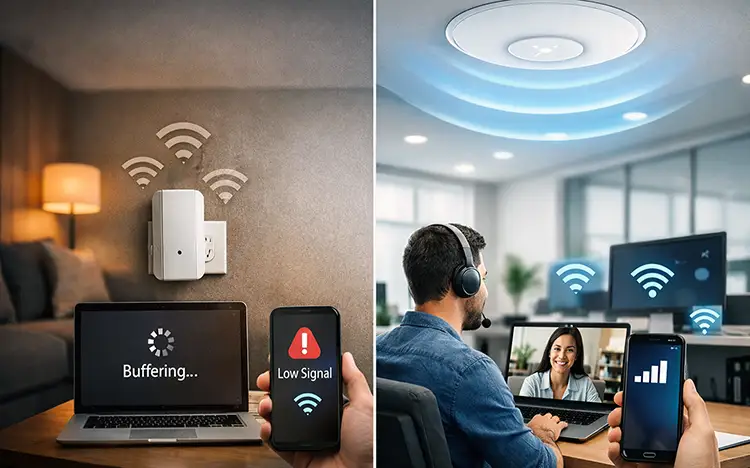
Latency is often overlooked until it becomes a problem. Video calls, online gaming, VoIP, and cloud-based work are all highly sensitive to delays and packet loss. WiFi extenders introduce additional hops and processing delays. Each retransmission adds latency, which can lead to audio dropouts, frozen video, or lag spikes.
Ubiquiti access points are optimized for low-latency performance. Features such as fast roaming, efficient airtime usage, and intelligent client steering ensure that devices remain connected to the best possible access point with minimal interruption. For environments where real-time communication matters, extenders quickly reach their limits, while access points remain stable under load.
Seamless Roaming and Mobility
One of the most noticeable differences between extenders and access points is roaming behavior. With extenders, devices often cling to a weak signal for too long, even when a stronger one is available. This results in slow speeds and dropped connections as users move around. Ubiquiti access points, when managed through a centralized controller, enable seamless roaming. Technologies such as 802.11k, 802.11v, and 802.11r help devices transition smoothly between access points without noticeable interruption. In offices, warehouses, hotels, or multi-floor homes, this makes a significant difference. Users can move freely without manually reconnecting or experiencing sudden performance drops.
Network Stability Under Load
WiFi extenders are designed for light usage. Once multiple devices connect, performance degrades rapidly. This is especially problematic in modern environments where smartphones, laptops, smart TVs, cameras, and IoT devices all compete for airtime. Ubiquiti access points are engineered to handle dozens or even hundreds of concurrent clients, depending on the model. Advanced features such as band steering, load balancing, and airtime fairness ensure that no single device degrades the experience for others. This stability is particularly important in business environments, but it also benefits households with many connected devices.
Centralized Management and Visibility
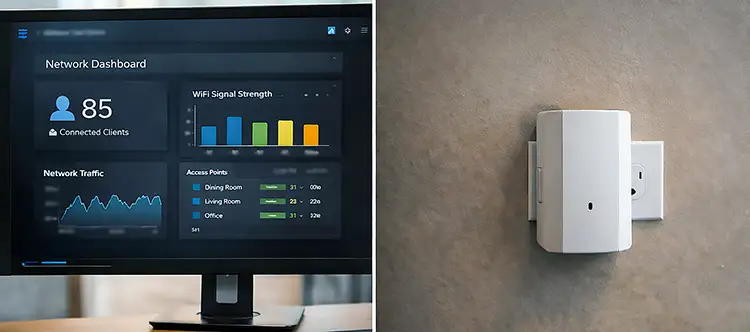
WiFi extenders are typically configured once and then forgotten. Troubleshooting is limited, and visibility into network performance is minimal. Ubiquiti access points are managed through a unified interface that provides detailed insights into signal strength, client behavior, interference, and traffic patterns. Administrators can see exactly where problems occur and address them proactively. Even for non-technical users, this level of visibility simplifies maintenance and allows for informed decisions about placement, channel selection, and capacity planning.
Scalability and Future Growth
Extenders do not scale well. Adding more extenders often worsens performance due to increased interference and overlapping channels. Networks built this way become fragile and unpredictable. Ubiquiti access points are designed for scalability. You can start with a single access point and expand gradually as coverage or capacity requirements grow. Each new access point integrates seamlessly into the existing network without major reconfiguration. This makes access points a long-term investment rather than a temporary workaround.
Security and Network Segmentation
Security is another area where extenders fall short. Many extenders offer limited encryption options and minimal control over connected devices. Ubiquiti access points support advanced security features, including WPA3, VLAN-based segmentation, guest networks, captive portals, and traffic isolation. These capabilities are essential for businesses but also valuable for homes where guest access and device isolation improve overall security. By separating critical devices from guest or IoT traffic, access points reduce risk and improve reliability.
Installation Flexibility and Optimal Placement
WiFi extenders are constrained by the need to receive a strong signal from the main router. This often forces placement in suboptimal locations, such as hallways or power outlets far from ideal coverage zones. Ubiquiti access points offer flexible mounting options, including ceiling, wall, and outdoor installations. Because they rely on Ethernet backhaul, they can be placed exactly where coverage is needed most. This flexibility leads to better signal distribution and fewer dead zones.
Total Cost of Ownership
At first glance, WiFi extenders appear cheaper. However, when considering performance limitations, replacement cycles, and user frustration, the total cost increases quickly. Ubiquiti access points have a higher initial cost but deliver significantly better value over time. Their durability, firmware support, and scalability reduce the need for frequent upgrades or troubleshooting. For businesses, the cost of downtime or poor connectivity far outweighs the price difference between extenders and access points.
Real-World Use Cases Where Access Points Excel
In small offices, access points ensure stable connectivity for cloud applications, video conferencing, and shared resources. In retail environments, they support POS systems and customer WiFi without interference. In homes, especially multi-story or large layouts, access points provide consistent coverage without the compromises of extenders. Streaming, gaming, and remote work all benefit from predictable performance. Outdoor models extend reliable coverage to gardens, warehouses, or parking areas, something extenders are not designed to handle effectively.
Why WiFi Extenders Still Exist
WiFi extenders are not inherently useless. They serve a purpose in very small, low-demand environments where running Ethernet is impossible and performance expectations are minimal. However, as soon as reliability, speed, and scalability become important, their limitations become apparent. They are best viewed as a temporary patch rather than a permanent solution.
Final Thoughts on Choosing the Right Solution
The difference between WiFi extenders and Ubiquiti access points is not incremental; it is architectural. Extenders attempt to stretch an existing signal, while access points build a proper wireless infrastructure. If you value stable speeds, low latency, seamless roaming, and long-term reliability, access points are the clear choice. Ubiquiti access points, in particular, combine enterprise-grade features with flexible deployment options that suit both homes and businesses. Investing in a proper access point-based network is not just about better WiFi today. It is about building a foundation that can grow and adapt as your connectivity needs evolve.