





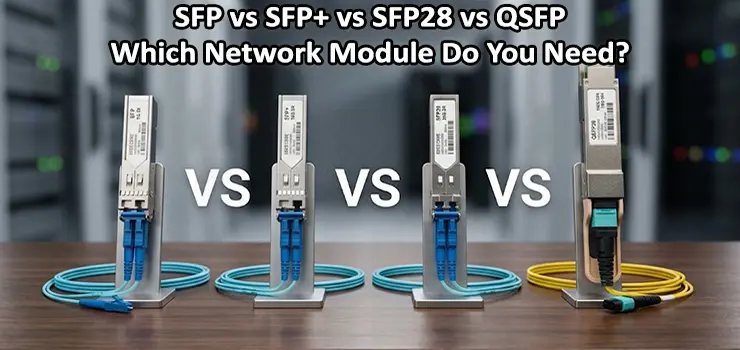
Modern enterprise networks depend on high-speed and reliable connectivity between switches, routers, servers, and storage systems. While Ethernet ports provide standard connectivity, many professional networking environments require flexible solutions for long-distance communication, higher bandwidth, and fiber optic connections. This is where network modules and transceiver modules become essential.
Among the most commonly used network modules are SFP, SFP+, SFP28, and QSFP modules. These small form-factor pluggable transceivers are widely used in Cisco switches, HPE servers, MikroTik networking equipment, data center switches, and enterprise network infrastructures. However, choosing the right module can be confusing. The difference between SFP vs SFP+, SFP28 vs QSFP is not only about speed. Factors such as compatibility, fiber type, transmission distance, network design, and future scalability must also be considered.
In this guide, we will compare SFP, SFP+, SFP28, and QSFP network modules and explain which option is the best choice for different networking requirements.
What Is a Network Module?
A network module is a hardware component that allows networking devices to connect through different types of cables and interfaces. These modules are usually installed into switch uplink ports, router interfaces, or server network adapters. Unlike fixed Ethernet ports, network modules provide flexibility because administrators can choose different transceivers depending on their requirements.
For example, a data center may use:
- Copper modules for short-distance connections
- Fiber optic modules for long-distance communication
- High-speed modules for server and storage connectivity
Common network module categories include:
- SFP modules for 1 Gigabit Ethernet
- SFP+ modules for 10 Gigabit Ethernet
- SFP28 modules for 25 Gigabit Ethernet
- QSFP modules for 40 Gigabit and higher speeds
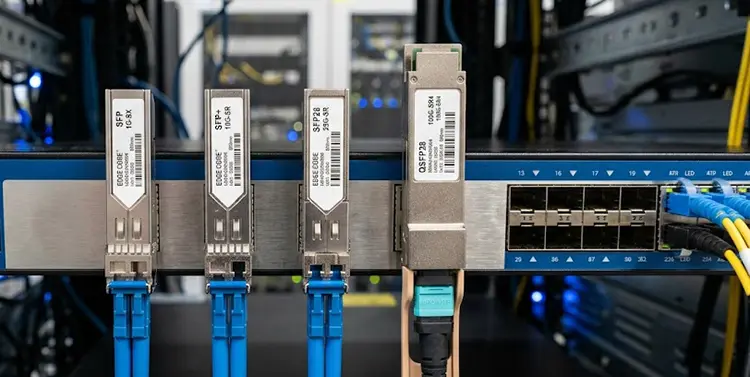
SFP Module Explained: The Standard 1G Network Module
What Is an SFP Module?
SFP (Small Form-factor Pluggable) is one of the most widely used network modules in enterprise networking. It was designed to replace older GBIC modules and provides a compact solution for Gigabit Ethernet connectivity. An SFP module typically supports speeds up to 1Gbps and is commonly used in access switches, routers, and enterprise networks. Examples of applications include:
- Connecting switches in different floors
- Fiber uplinks between network cabinets
- Connecting security devices
- Enterprise LAN environments
Common Types of SFP Modules
SFP modules are available in different versions depending on cable type and transmission distance.
1. SFP SX (Multimode Fiber)
- Speed: 1Gbps
- Fiber type: Multimode
- Distance: Up to approximately 550 meters
Suitable for:
- Office buildings
- Short-distance switch connections
- Internal data center links
2. SFP LX (Single Mode Fiber)
- Speed: 1Gbps
- Fiber type: Single mode
- Distance: Up to 10 kilometers
Suitable for:
- Campus networks
- Long-distance fiber connections
- ISP environments
SFP+ Module Explained: The 10G Ethernet Solution
What Is an SFP+ Module?
SFP+ is an improved version of the original SFP standard. The main difference between SFP and SFP+ is the supported bandwidth. While SFP supports 1 Gigabit Ethernet, SFP+ supports 10 Gigabit Ethernet. SFP+ modules are commonly used in:
- Data centers
- Core switches
- Server uplinks
- Storage networks
- High-performance enterprise environments
SFP vs SFP+: Key Differences
| Feature | SFP | SFP+ |
|---|---|---|
| Maximum Speed | 1Gbps | 10Gbps |
| Standard | Gigabit Ethernet | 10 Gigabit Ethernet |
| Common Use | Access networks | Data centers and backbone networks |
| Cable Support | Fiber/Copper | Fiber/Copper |
| Latency | Higher | Lower |
One important advantage is that many SFP+ ports are backward compatible with SFP modules. However, an SFP module cannot provide 10Gbps speed inside an SFP+ port.
SFP28 Module Explained: The 25G Network Module
What Is SFP28?
SFP28 is the next generation of SFP technology and was designed for 25 Gigabit Ethernet connectivity. Although SFP28 looks physically identical to SFP and SFP+, it supports much higher bandwidth. SFP28 modules are becoming increasingly popular in modern data centers because they provide better performance without requiring larger interfaces.
Why Choose SFP28 Instead of SFP+?
Many organizations are upgrading from 10Gbps networks to 25Gbps because modern applications require more bandwidth. SFP28 provides:
- Higher network capacity
- Lower power consumption compared with multiple 10G links
- Better scalability
- Improved server connectivity
Typical applications include:
- Cloud infrastructure
- Virtualization environments
- High-performance servers
- Storage networks

QSFP Module Explained: High-Speed Data Center Connectivity
What Is QSFP?
QSFP (Quad Small Form-factor Pluggable) is designed for high-speed networking applications. Unlike SFP-based modules that usually use one transmission channel, QSFP modules combine multiple channels to achieve significantly higher speeds. Common QSFP speeds include:
- 40Gbps
- 100Gbps
- 200Gbps
- 400Gbps
QSFP vs SFP28: Which One Is Better?
The choice between QSFP and SFP28 depends on network requirements.
| Feature | SFP28 | QSFP |
|---|---|---|
| Speed | 25Gbps | 40Gbps+ |
| Port Size | Smaller | Larger |
| Main Usage | Server connections | Switch uplinks and backbone |
| Data Center Use | High-performance servers | Core networking |
QSFP modules are commonly used for:
- Switch-to-switch connections
- Data center backbone links
- Core network infrastructure
SFP, SFP+, SFP28, and QSFP Compatibility
One of the most important factors when purchasing network modules is compatibility. Before selecting a module, check:
1. Switch or Router Compatibility
Not every module works with every networking device. For example:
- Cisco switches may require Cisco-compatible transceivers
- HPE switches may require HPE-coded modules
- MikroTik devices may support specific SFP/SFP+ models
Always verify the supported module list from the manufacturer.
2. Fiber Type
Network modules are available for different fiber standards:
Multimode Fiber (MMF)
Common for:
- Short-distance connections
- Data centers
- Server rooms
Single Mode Fiber (SMF)
Common for:
- Long-distance links
- Campus networks
- ISP applications
3. Transmission Distance
Different modules support different distances. Examples:
- SFP SX: around 550m
- SFP LX: up to 10km
- SFP+ SR: short-range 10G
- SFP+ LR: long-range 10G
- SFP28 SR: short-range 25G
- QSFP LR4: long-distance 100G connections
Which Network Module Should You Choose?
For Small Businesses and Office Networks
If your network requires basic fiber connectivity: Choose:
- SFP 1G modules
Recommended for:
- Access switches
- Standard office networks
- Basic uplinks
For Enterprise Networks
For modern enterprise environments: Choose:
- SFP+ 10G modules
Recommended for:
- Core switches
- Server uplinks
- Virtualization networks
For Data Centers
For high-performance infrastructure: Choose:
- SFP28 25G modules
- QSFP 40G/100G modules
Recommended for:
- Server clusters
- Storage systems
- Cloud environments
Common Mistakes When Buying Network Modules
Many network problems happen because the wrong module is selected. Common mistakes include:
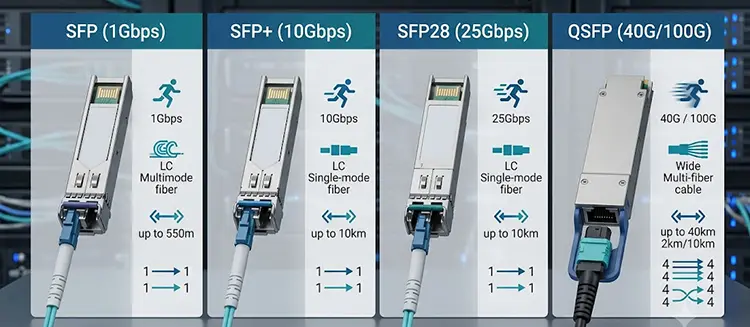
- Buying a module with incorrect speed: A 1G SFP module cannot provide 10G performance.
- Ignoring device compatibility: A physically compatible module may not work because of coding restrictions.
- Choosing the wrong fiber type: Using multimode modules with single-mode fiber can cause connectivity problems.
- Ignoring future upgrades: Choosing a lower-speed module may create limitations when the network grows.
Why Network Modules Are Important for Modern Networks
As businesses increase their dependence on cloud applications, virtualization, video communication, and large data transfers, network bandwidth requirements continue to grow. Choosing the right network module helps organizations achieve:
- Faster communication
- Reliable connections
- Lower latency
- Easier network expansion
- Better infrastructure investment
Whether you need a Cisco SFP module, HPE transceiver, MikroTik SFP+ module, or high-speed QSFP solution, selecting the correct technology is essential for network performance.
Final Thoughts: SFP vs SFP+ vs SFP28 vs QSFP
The main difference between SFP, SFP+, SFP28, and QSFP network modules is their speed capability and intended application.
- SFP is ideal for 1Gbps connections.
- SFP+ is designed for 10Gbps enterprise networking.
- SFP28 provides 25Gbps connectivity for modern servers and data centers.
- QSFP delivers high-speed connections from 40Gbps to 400Gbps for backbone networks.
Before purchasing a network module, always consider your device compatibility, required bandwidth, cable type, transmission distance, and future expansion plans. Choosing the right network module ensures a stable, scalable, and high-performance network infrastructure.