








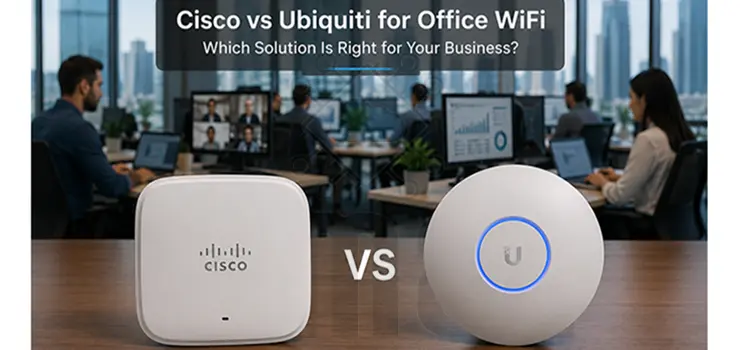
If you’re planning to upgrade your office wireless network, you’ve probably searched for Cisco vs Ubiquiti for Office WiFi. Both brands have earned an excellent reputation in the networking industry, yet they are designed with different business priorities in mind. Cisco has long been the preferred choice for large enterprises that demand advanced security, high availability, and extensive network control. Ubiquiti, on the other hand, has transformed the SMB market by offering enterprise-inspired features at a much more accessible price point.
The problem is that many comparisons focus only on specifications or pricing. In reality, choosing the right wireless platform is about much more than comparing WiFi standards or maximum throughput. The right decision depends on your office size, the number of connected devices, the applications your employees rely on, your growth plans, and how much time your IT team wants to spend managing the network.
A poorly designed WiFi network doesn’t just create slow internet speeds. It leads to unstable video meetings, dropped VoIP calls, roaming issues between meeting rooms, slow access to cloud applications, and frustrated employees who constantly reconnect their laptops or smartphones. Even the most expensive access points cannot compensate for poor network design.
This guide takes a practical approach to Cisco vs Ubiquiti for Office WiFi, explaining where each platform excels, where each falls short, and which solution makes the most sense for different types of businesses.
Cisco vs Ubiquiti for Office WiFi: Understanding What Really Matters
When businesses compare wireless networking solutions, they often focus on hardware specifications. They compare WiFi 6, WiFi 6E, or WiFi 7 support, maximum data rates, antenna counts, or advertised coverage. While these specifications are important, they rarely determine how your office network performs in everyday use.
A modern office network must support dozens—or even hundreds—of devices simultaneously. Employees move between desks, meeting rooms, and shared workspaces while remaining connected to video conferences, cloud storage, CRM platforms, and VoIP systems. Guest devices connect throughout the day, while printers, IP phones, security cameras, and IoT equipment continuously communicate with the network.
In this environment, the quality of the wireless infrastructure depends on several factors working together. Fast roaming between access points, intelligent channel selection, interference management, load balancing, and proper RF optimization have a much greater impact than simply buying an access point with the highest advertised speed.
This is where the biggest differences between Cisco and Ubiquiti begin to appear.
Cisco vs Ubiquiti for Office WiFi in a Real Business Environment
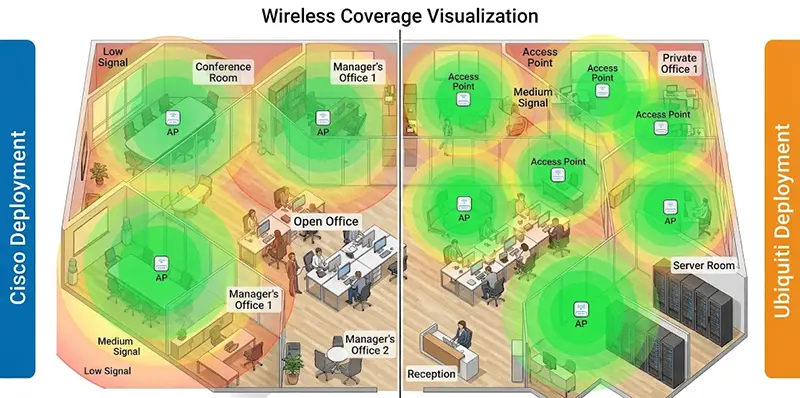
Imagine you’re opening a new office with around 80 employees. Each employee carries a laptop and a smartphone. Meeting rooms are equipped with Microsoft Teams or Zoom devices, visitors require guest WiFi, and cloud applications such as Microsoft 365, Google Workspace, and Salesforce are used throughout the day. At first glance, both Cisco and Ubiquiti can provide wireless coverage across the office. Employees will connect, browse the web, and access company resources without any obvious problems. However, as the office becomes busier, differences emerge.
During a company-wide meeting, dozens of users join simultaneous video calls. Large file uploads begin, cloud backups run in the background, and multiple meeting rooms become active at the same time. The wireless network suddenly faces a high-density environment where efficient airtime management becomes more important than raw bandwidth. Cisco has spent decades refining technologies that optimize these situations.
Features such as Radio Resource Management (RRM), intelligent client steering, dynamic transmit power adjustment, and advanced roaming algorithms continuously optimize wireless performance without requiring manual intervention. Ubiquiti also performs exceptionally well in most office environments. The UniFi ecosystem provides reliable roaming, automatic channel optimization, centralized management, and excellent wireless performance. For the majority of small and medium-sized businesses, employees are unlikely to notice a difference during everyday work.
The important distinction is that Cisco is engineered for organizations where network interruptions can have significant operational or financial consequences, while Ubiquiti focuses on delivering outstanding value with simplified management.
Cisco vs Ubiquiti for Office WiFi: Performance Under Heavy Load
Wireless performance isn’t measured by a speed test performed with a single laptop standing next to an access point. Real performance is determined by how the network behaves when many users compete for airtime simultaneously. Consider a co-working office where 150 people are connected throughout the day. Video conferences, cloud storage synchronization, wireless printing, security cameras, and guest traffic all compete for wireless resources.
Cisco excels in these demanding environments because of its sophisticated RF optimization technologies. Rather than simply providing wireless coverage, Cisco continuously evaluates interference levels, client behavior, and channel utilization to maximize efficiency across the network. Ubiquiti has made enormous progress in recent years. Modern UniFi access points support OFDMA, MU-MIMO, band steering, airtime fairness, and advanced roaming capabilities that significantly improve client performance.
For offices with moderate client density, the user experience is often excellent. This is why many businesses discover that spending significantly more on Cisco hardware doesn’t necessarily produce noticeably faster WiFi. If your office has fewer than 100 active wireless users at any given time, careful network design will usually have a greater impact than choosing the more expensive platform.
Security: Where Cisco Still Holds a Clear Advantage
Security is one of Cisco’s strongest differentiators. Large enterprises often require advanced authentication policies, identity-based network access, detailed segmentation, compliance reporting, and integration with broader cybersecurity platforms. Cisco has developed an extensive ecosystem that integrates wireless networking with enterprise security architecture.
Organizations operating in banking, healthcare, government, education, or large corporate environments frequently choose Cisco because these capabilities simplify compliance while reducing operational risk.
Ubiquiti also supports modern security standards including WPA3 encryption, VLAN segmentation, guest isolation, multiple SSIDs, and RADIUS authentication. These features are more than adequate for most offices, retail stores, clinics, restaurants, and commercial buildings. The difference isn’t that Ubiquiti is insecure. Rather, Cisco provides additional layers of policy control and enterprise integration that many smaller businesses simply don’t require.
Cisco vs Ubiquiti for Office WiFi: Ease of Deployment and Daily Management
Technology should simplify business operations, not create additional administrative work. This is one of the primary reasons UniFi has become so popular worldwide. The UniFi Controller allows administrators to manage access points, switches, gateways, cameras, and other devices from a single interface. Firmware updates can be applied across multiple sites with minimal effort, performance analytics are easy to understand, and troubleshooting common wireless issues requires far less expertise than traditional enterprise platforms.
For growing businesses without dedicated network engineers, this simplicity represents enormous value. Cisco provides considerably deeper configuration capabilities. Experienced administrators gain access to granular policy management, advanced diagnostics, automation, and enterprise monitoring tools. However, these capabilities also introduce additional complexity that smaller organizations may never fully utilize.
For many businesses, the easiest network to manage is ultimately the one that delivers the greatest long-term value.
Why Network Design Is More Important Than the Brand
One of the biggest misconceptions in office networking is that buying premium hardware automatically guarantees excellent wireless performance. In reality, many WiFi problems originate long before employees connect to the network. Access points installed too close together can create unnecessary interference. Incorrect transmit power settings may prevent devices from roaming properly. Poor channel planning can increase congestion, while low-quality cabling or insufficient PoE switching may limit overall reliability.
We’ve seen offices equipped with expensive enterprise hardware perform worse than offices using more affordable equipment simply because the wireless design was incorrect. Before selecting Cisco or Ubiquiti, businesses should evaluate floor plans, wall materials, user density, application requirements, and future expansion plans. A professional wireless site survey and proper RF design often produce far greater improvements than changing hardware vendors.
Which Businesses Should Choose Cisco?
Cisco remains one of the strongest choices for organizations where network reliability is absolutely critical. Large corporate headquarters, hospitals, universities, financial institutions, manufacturing facilities, airports, and government organizations often benefit from Cisco’s advanced management capabilities and enterprise-grade resilience.
Businesses with dedicated IT departments also gain significant value from Cisco’s extensive monitoring, automation, and security ecosystem. Although the initial investment is higher, these organizations often justify the cost through reduced downtime and long-term operational stability.
Which Businesses Should Choose Ubiquiti?
For many small and medium-sized businesses, Ubiquiti represents an outstanding balance between performance and affordability. Professional offices, law firms, accounting companies, retail stores, restaurants, warehouses, logistics companies, hotels, clinics, and startups frequently choose UniFi because it delivers reliable wireless networking without the complexity of traditional enterprise solutions.
The ability to manage multiple office locations from a single interface is particularly attractive for businesses with several branches. As organizations grow, additional access points and switches can be integrated into the existing infrastructure with minimal disruption, making UniFi an excellent long-term investment for expanding companies.
Cisco vs Ubiquiti for Office WiFi: Final Verdict
The answer to Cisco vs Ubiquiti for Office WiFi depends less on the hardware itself and more on your business requirements. Cisco is designed for organizations that require maximum scalability, advanced security, sophisticated network control, and enterprise-grade resilience. Its capabilities make it an excellent choice for large, complex environments where network availability is mission-critical.
Ubiquiti, meanwhile, has redefined what businesses can expect from affordable networking. It offers impressive wireless performance, centralized management, modern security features, and excellent scalability for the majority of office environments—all while keeping deployment and maintenance costs significantly lower.
For most offices with 20 to 200 employees, a professionally designed Ubiquiti deployment can provide an exceptional user experience. For larger enterprises with demanding compliance requirements or highly complex infrastructures, Cisco remains the benchmark.
Ultimately, the best WiFi network is not determined solely by the logo on the access point. It is the result of thoughtful planning, proper installation, intelligent RF design, and ongoing optimization.

Office Network Installation & Ubiquiti Access Point Installation in Dubai
A successful office WiFi deployment starts with more than choosing Cisco or Ubiquiti—it starts with proper planning and professional installation. At ITMan, we provide complete Office Network Installation in Dubai for businesses of every size, from small offices to multi-floor corporate environments. Our services include wireless site surveys, structured cabling, rack installation, PoE switch deployment, VLAN configuration, guest WiFi setup, firewall integration, and complete office network design.
We also specialize in Ubiquiti Access Point Installation in Dubai, helping businesses deploy UniFi WiFi solutions that deliver seamless roaming, strong wireless coverage, and reliable performance across the workplace. Whether you need a new Office WiFi Setup in Dubai, a Cisco wireless deployment, a UniFi network upgrade, or optimization of an existing business network, our engineers design every installation based on your office layout, user density, and future growth plans. By combining the right hardware with professional implementation, we help businesses build secure, scalable, and high-performance wireless networks that support modern work without compromise.