







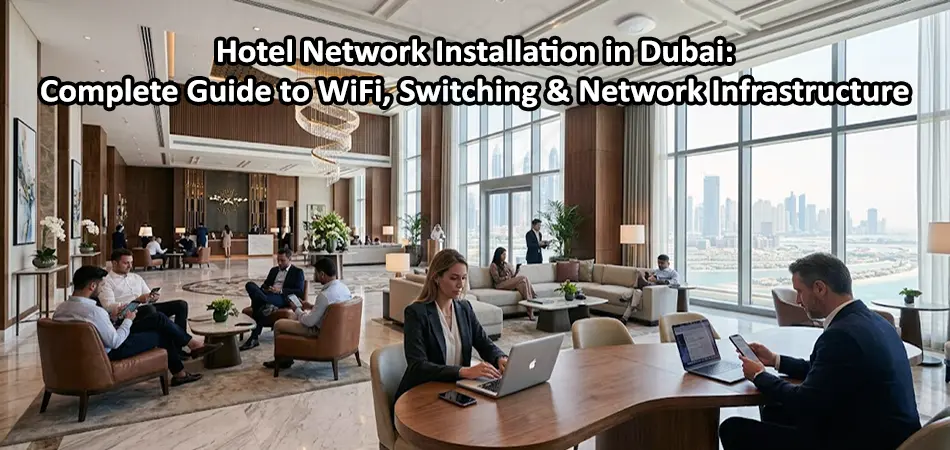
A reliable network is one of the most important infrastructures in a modern hotel. Guests expect fast and stable WiFi from the moment they enter the lobby until they leave the property. At the same time, hotel staff need a secure and reliable network for reception systems, CCTV, POS terminals, VoIP phones, access control, back-office applications, and other operational services. This is why professional Hotel Network Installation requires much more than simply installing several wireless access points.
A hotel network must be designed around high user density, continuous operation, security, mobility, and different types of network traffic. In Dubai, where hotels range from small boutique properties to large multi-floor hotels and serviced apartments, the network infrastructure must also be scalable and easy to maintain.
A professional Hotel Network Installation in Dubai normally combines enterprise WiFi, managed switches, fiber optic links, structured cabling, VLANs, firewall security, PoE infrastructure, and centralized network management. The objective is not only to provide WiFi coverage, but to create a stable infrastructure that can support the hotel’s current requirements and future expansion.
Why Is a Hotel Network Different from an Office Network?
Although hotels and offices both use switches, routers, wireless networks, and structured cabling, their requirements are considerably different. An office network generally serves a relatively predictable group of users. Employees may work from fixed desks, and the number of devices connected to the network is usually easier to estimate. A hotel, however, has constantly changing users. Guests arrive and leave every day, connect multiple devices, move between floors and areas, and expect uninterrupted connectivity.
A hotel may simultaneously have hundreds of smartphones, laptops, tablets, smart TVs, POS terminals, IP phones, CCTV cameras, access control systems, printers, servers, and IoT devices connected to the infrastructure. This makes Hotel Network Installation a high-density networking project where wireless capacity, roaming, segmentation, redundancy, and security are especially important.
What Does Hotel Network Installation Include?
A complete Hotel Network Installation can cover several infrastructure layers. Each layer has to be designed as part of the overall network rather than installed independently.
WiFi / Access Points
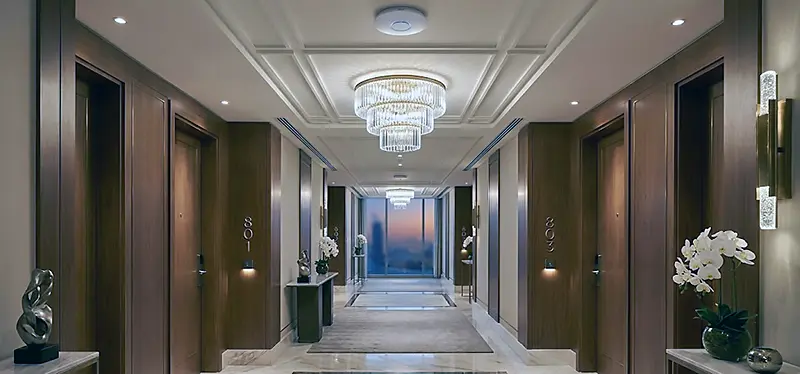
Wireless access points are the most visible part of a hotel network because guests interact with them directly. However, installing more APs does not automatically create a better network. Access points should be positioned according to the hotel’s floor plan, wall construction, room layout, expected client density, interference, and bandwidth requirements. Guest rooms, corridors, meeting rooms, restaurants, lobbies, pools, and outdoor areas can all require different WiFi designs. Enterprise-grade APs from manufacturers such as Cisco or Ubiquiti can provide centralized management, VLAN support, roaming capabilities, monitoring, and detailed wireless configuration.
Network Switches
Switches provide the wired foundation of the hotel network. Access points, CCTV cameras, IP phones, servers, POS systems, and other devices may connect directly to switches. Managed switches are generally preferred because they support VLANs, QoS, monitoring, link aggregation, and security features. For hotel deployments, PoE switches are particularly useful because they can deliver both network connectivity and electrical power to compatible access points and other devices through Ethernet cabling.
Fiber Optics
Fiber optic cabling is often used for backbone connections between different floors, communication rooms, and network cabinets. For a multi-floor hotel, using fiber between distribution points can provide high bandwidth, low latency, and reliable long-distance connectivity. Fiber also reduces the limitations associated with long copper cable runs. A properly planned Hotel Network Installation should consider the hotel’s backbone architecture from the beginning rather than adding fiber links after the network becomes overloaded.
Structured Cabling
Copper structured cabling connects access points, computers, IP phones, cameras, POS devices, and other endpoints to network switches. Depending on the project requirements, Cat6 or Cat6A cabling may be selected. Cable routes, maximum distances, patch panels, labeling, cable management, and testing should all be considered during installation. Poor cabling can create intermittent connectivity problems that are difficult to diagnose later, so professional installation and certification are important.
Server & Rack
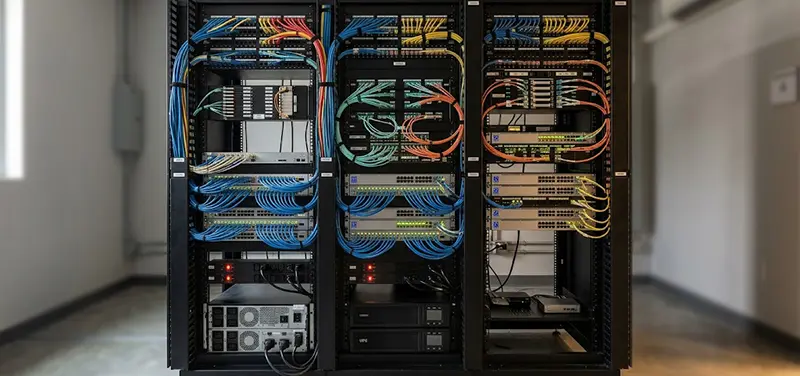
The network infrastructure should be organized inside properly designed racks or network cabinets. Depending on the hotel’s requirements, racks may contain switches, patch panels, fiber termination equipment, firewalls, UPS systems, servers, and cable management accessories. A clean rack design makes troubleshooting and future expansion significantly easier.
Firewall
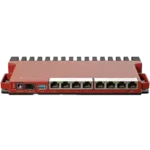
The firewall controls traffic between the hotel network and the Internet and can provide security functions such as access control, NAT, VPN, traffic filtering, and threat prevention. A hotel firewall must be capable of handling the expected Internet bandwidth and the number of simultaneous connections generated by guests and staff.
Guest Network
Guest WiFi should be isolated from internal hotel systems. A guest connecting to the hotel’s WiFi should never be able to access reception computers, servers, CCTV systems, printers, or administrative devices. This is normally achieved using VLAN segmentation, firewall policies, client isolation, and appropriate wireless security settings.
Hotel WiFi Network Design
A successful Hotel Network Installation begins with proper WiFi design rather than simply mounting access points on ceilings.
Designing for Rooms, Lobby, Restaurant, Pool and Public Areas
Different hotel areas have different wireless requirements. Guest rooms may require reliable connectivity through walls and doors, while lobbies can experience extremely high client density during check-in and check-out periods. Restaurants may have many simultaneous mobile devices, and meeting rooms can suddenly experience a large number of connected clients during conferences or events.
Swimming pools and outdoor spaces create additional challenges because coverage requirements extend beyond the main building and environmental conditions may affect equipment selection. The WiFi design should therefore consider both coverage and capacity.
WiFi Coverage
Coverage refers to whether a wireless signal reaches a particular area. However, a strong signal alone does not guarantee good performance. A hotel may have excellent signal strength while still experiencing slow WiFi because too many users are connected to the same access point or because the AP is operating on a congested channel. Professional Hotel Network Installation therefore considers signal strength, channel utilization, interference, client density, expected bandwidth, and AP capacity.
Seamless Roaming
Hotel guests constantly move between rooms, corridors, elevators, lobbies, restaurants, and other areas. Their devices should be able to move between access points without noticeable interruption. Proper roaming requires more than using the same SSID on every AP. Channel planning, transmit power, AP placement, authentication configuration, and roaming technologies all affect the experience. A properly designed network can allow a smartphone or laptop to transition between access points with minimal interruption.
Guest WiFi vs Staff Network
Guest and staff traffic should not share the same unrestricted network. For example, the guest network may provide Internet access only, while the staff network can provide access to hotel management systems, printers, POS terminals, and internal applications. This separation reduces security risks and makes network management considerably easier.
VLAN Segmentation
VLANs are a fundamental component of a secure hotel network. Instead of placing every device into one large broadcast domain, different services can be separated logically. A hotel might use separate VLANs for guests, staff, CCTV, VoIP, servers, management, and other infrastructure. For example, even if a guest obtains the IP address of an internal device, firewall and VLAN policies can prevent unauthorized communication between the guest network and internal systems.
Security
Security should be incorporated into the network design from the beginning. Strong WiFi authentication, VLAN segmentation, firewall policies, secure management interfaces, firmware updates, monitoring, and access control all contribute to a safer environment. Hotel networks are particularly sensitive because they serve a large number of temporary users whose devices cannot be trusted by default.
Bandwidth Management
Internet bandwidth can quickly become saturated in hotels, particularly during peak hours. If dozens or hundreds of guests are streaming video, downloading files, joining video calls, or using cloud applications simultaneously, the connection can become congested. Bandwidth management allows administrators to control how network resources are distributed. Guest traffic can be assigned appropriate limits while critical hotel services receive higher priority. Quality of Service (QoS) can also help prioritize applications such as VoIP or business-critical traffic.
PoE Switches for Hotel Access Points
PoE is one of the most practical technologies used in modern Hotel Network Installation.
Why Is PoE Important?
Power over Ethernet allows compatible devices to receive electrical power through the same Ethernet cable used for data. This is particularly useful for ceiling-mounted WiFi access points because there is no need to install a separate electrical outlet beside every AP. PoE can also simplify deployment of IP cameras, VoIP phones, access control devices, and other network-powered equipment.
Calculating PoE Budget
Choosing a PoE switch requires more than checking the number of ports.The total PoE budget must be sufficient for all connected devices operating simultaneously. For example, if a switch has 48 PoE ports but its total power budget is limited, it may not be capable of powering 48 high-power devices at their maximum consumption. During Hotel Network Installation, the power requirements of access points and other PoE devices should be calculated before selecting the switches.
How Many Access Points Does a Hotel Need?
There is no universal number of access points for every hotel.cThe required AP count depends on the number of rooms, floor area, building materials, room layout, expected number of users, bandwidth requirements, and the type of applications guests are expected to use.
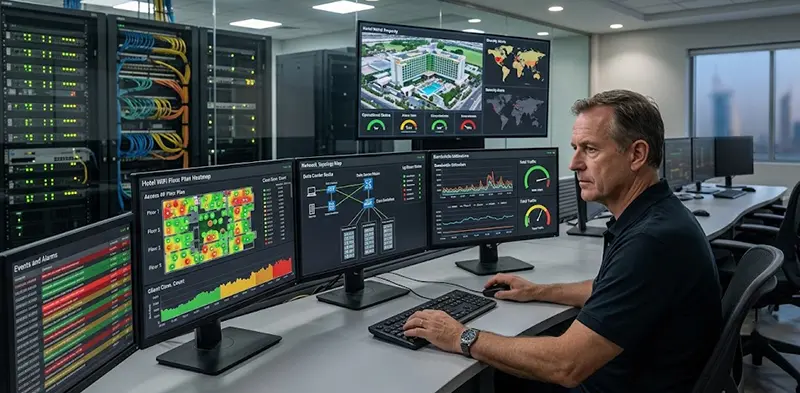
For example, an AP layout designed for a small boutique hotel cannot simply be duplicated in a large conference hotel. A professional site survey is therefore one of the most important stages of Hotel Network Installation. Heat maps and wireless measurements can identify weak areas, interference sources, and high-density zones before equipment is permanently installed.
Network Security for Hotels
- Guest Isolation: Guest isolation prevents hotel guests from communicating directly with other guest devices or internal resources. This is particularly important because the hotel cannot control the security posture of every guest’s smartphone, laptop, or tablet.
- Firewall: The firewall should enforce communication policies between Internet traffic, guest VLANs, staff VLANs, servers, cameras, and management networks. For example, guest devices may be allowed to access the Internet while being denied access to private RFC1918 networks used by hotel infrastructure.
- VLAN: VLANs provide logical separation at the switching and network layers. Combined with firewall rules, they create a structured security architecture.
- Captive Portal: Many hotels use a captive portal to provide a branded guest login or acceptance page before Internet access is granted. The portal can be used for terms and conditions, guest authentication, vouchers, or other access policies depending on the hotel’s requirements.
Cisco vs Ubiquiti for Hotel Networks
Both Cisco and Ubiquiti can be used in hotel networking, but the appropriate choice depends on the project’s size, complexity, budget, and management requirements. Cisco is often preferred for larger enterprise environments where advanced switching, security, redundancy, centralized management, detailed control, and extensive enterprise features are priorities.
Ubiquiti can be an attractive option for hotels looking for a simpler centralized management experience and a strong balance between functionality and deployment cost. UniFi equipment can provide integrated management of access points, switches, gateways, and other network components. The best solution is not necessarily the brand with the highest specification. It is the architecture that matches the hotel’s operational requirements.
Hotel Network Installation Process
A professional Hotel Network Installation should follow a structured implementation process.
Site Survey → Design → Cabling → Installation → Configuration → Testing
The project normally starts with a site survey. The building structure, floor plans, existing infrastructure, Internet connection, equipment locations, and wireless requirements are assessed. The next stage is network design. This includes AP placement, switch selection, fiber backbone planning, VLAN architecture, IP addressing, firewall policies, rack layouts, and bandwidth requirements.
After the design is approved, structured cabling and fiber infrastructure can be installed. Patch panels, racks, switches, access points, and other hardware are then deployed. Configuration is the next stage. Switches, VLANs, DHCP, wireless SSIDs, authentication, firewall policies, routing, QoS, and management systems are configured according to the network design.
Finally, the network should be tested. Testing can include cable certification, fiber testing, Internet performance, WiFi coverage, roaming, VLAN isolation, PoE operation, firewall policies, and connectivity between critical hotel systems.
How Much Does Hotel Network Installation Cost in Dubai?
The cost of Hotel Network Installation in Dubai varies significantly from one project to another, so providing one fixed price without assessing the property would not be reliable. The main cost factors include the number of floors and rooms, total building area, number of access points, switch quantity and model, PoE requirements, fiber optic infrastructure, structured cabling, rack equipment, firewall selection, Internet bandwidth, existing infrastructure, and the complexity of the required configuration.
A small hotel with an existing structured cabling system may require a relatively straightforward WiFi and switching upgrade. A newly constructed multi-floor hotel, on the other hand, may require complete cabling, fiber backbone installation, racks, enterprise switching, wireless deployment, firewall configuration, and extensive testing. For this reason, a professional site survey and project assessment are recommended before preparing a quotation.
Why Choose ITMan for Hotel Network Installation in Dubai?
A successful hotel network requires more than selling network equipment. The infrastructure needs to be designed, installed, configured, tested, and maintained as a complete system. ITMan provides Hotel Network Installation services in Dubai with a focus on network infrastructure, enterprise switching, WiFi deployment, structured cabling, fiber connectivity, and network configuration.
- Design: The network can be designed according to the hotel’s floor plan, expected number of users, coverage requirements, Internet bandwidth, security requirements, and future expansion plans.
- Installation: Professional installation covers network cabinets, switches, access points, structured cabling, fiber infrastructure, and other required equipment.
- Configuration: Switches, VLANs, SSIDs, routing, firewall rules, DHCP, PoE, wireless settings, guest access, and other network components can be configured according to the project’s architecture.
- Troubleshooting: Existing hotel networks can develop problems such as WiFi dead zones, unstable connections, slow Internet, roaming issues, overloaded switches, VLAN misconfiguration, or faulty cabling. Network troubleshooting can identify the underlying cause rather than simply replacing equipment.
- Maintenance: Hotel networks operate continuously, so maintenance is important for long-term reliability. Monitoring, configuration reviews, firmware updates, troubleshooting, and capacity planning can help prevent network problems from affecting guests and hotel operations.
Conclusion
A professional Hotel Network Installation is the foundation of reliable digital services in a modern hotel. From guest WiFi and seamless roaming to PoE switching, fiber backbones, structured cabling, VLAN segmentation, firewall security, and bandwidth management, every component needs to work together. The right design depends on the hotel’s physical layout, number of rooms, expected user density, applications, security requirements, and future growth. Simply installing more access points or upgrading the Internet connection cannot solve every networking problem.
For hotels in Dubai, a properly planned Hotel Network Installation can provide better WiFi performance for guests while giving staff a secure, manageable, and scalable infrastructure for daily operations. Whether the project requires a new network from the ground up or an upgrade to an existing hotel infrastructure, starting with a professional site survey and network design is the most effective way to build a reliable solution.