





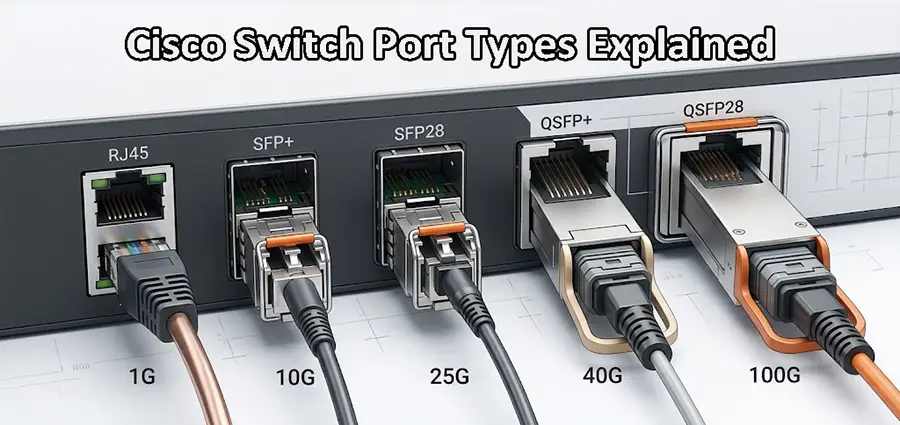
Choosing the right switch port speed is an important part of designing a reliable and high-performance network. Cisco switches are available with different port types and speeds, including 1G, 10G, 25G, 40G, and 100G Ethernet. Each speed is designed for different networking requirements, from connecting everyday office devices to building high-capacity data center networks.
Understanding the differences between Cisco switch port types can help businesses select the right switch, avoid unnecessary network bottlenecks, and plan for future bandwidth requirements. A 1G port may be more than enough for a standard workstation, while servers, storage systems, virtualization platforms, and network uplinks may require 10G, 25G, 40G, or even 100G connectivity.
This guide explains the most common Cisco switch port speeds, how they work, where they are typically used, and what businesses should consider when choosing between them.
What Are Cisco Switch Port Types?
A switch port is the physical interface used to connect a network device to a Cisco switch. Depending on the switch model, the port can support different Ethernet speeds, connector types, transceiver modules, and networking technologies. The port speed determines how much data can theoretically be transferred through the connection. For example, a 1G Ethernet port provides a maximum theoretical bandwidth of 1 gigabit per second, while a 100G port can provide up to 100 gigabits per second.
However, port speed is not the only factor that matters. The actual performance of a network connection also depends on the switch architecture, transceiver, cabling, server network adapter, traffic patterns, configuration, and the capabilities of the device connected to the port. Cisco offers switches with a wide range of interfaces, from traditional Gigabit Ethernet ports to high-speed interfaces designed for modern data centers and enterprise networks.
1G Cisco Switch Ports
1G, or Gigabit Ethernet, remains one of the most common network speeds for business environments. A 1G port can provide up to 1 gigabit per second of theoretical bandwidth and is widely used for connecting desktop computers, printers, access points, IP phones, cameras, and other standard network devices.
Many Cisco access switches use 1G Ethernet ports because they provide a good balance between performance, cost, and compatibility. For typical office users, a 1G connection is often sufficient for web browsing, cloud applications, file sharing, VoIP, and normal business workloads.
Cisco Gigabit Ethernet ports may use copper RJ45 connections or fiber-based SFP interfaces, depending on the switch model. Copper connections are convenient for standard office installations, while fiber can be useful for longer distances and connections between network infrastructure components. Although 1G is still widely deployed, businesses with increasing cloud usage, large file transfers, virtualization, and high-bandwidth applications may eventually need faster connections.
10G Cisco Switch Ports
10G Ethernet provides ten times the theoretical bandwidth of a 1G connection, making it an important upgrade for modern enterprise networks. 10G Cisco switch ports are commonly used for server connections, network uplinks, storage systems, virtualization hosts, and connections between switches. They are particularly useful when multiple users or applications generate significant network traffic.
For example, a server running several virtual machines may need substantially more bandwidth than a typical desktop computer. Connecting that server to a Cisco switch through a 10G interface can reduce network congestion and improve data transfer performance.
Cisco 10G ports are commonly available through SFP+ interfaces. SFP+ provides flexibility because the same switch interface can use different compatible transceivers and fiber or direct-attach cables depending on the required distance and installation. 10G is also frequently used as an uplink speed. Instead of connecting an access switch to the core network with a single 1G link, an organization can use 10G uplinks to provide significantly more aggregate bandwidth for connected users.
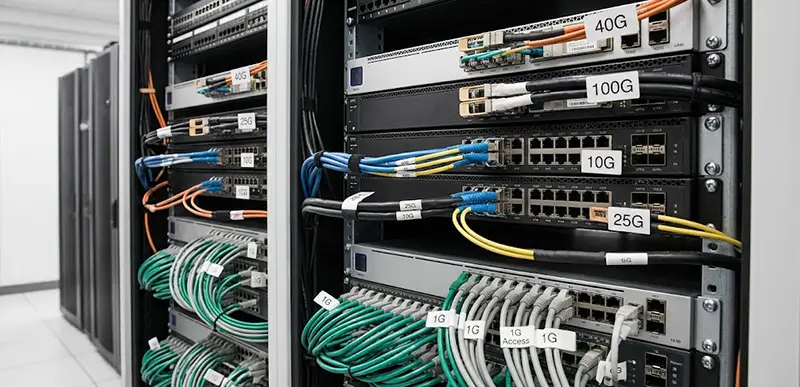
25G Cisco Switch Ports
25G Ethernet has become increasingly important in data center networking because it provides higher bandwidth than 10G while maintaining an efficient physical interface. A 25G Cisco switch port is commonly used for high-performance server connections, virtualization environments, data center networks, and storage applications. It is particularly attractive when organizations need more bandwidth than 10G but do not necessarily need 40G or 100G connectivity at the individual server level.
One of the major advantages of 25G is its ability to provide significantly higher bandwidth per server without requiring a much more complex architecture. Modern servers equipped with 25G network adapters can connect directly to compatible Cisco switches using appropriate SFP28 transceivers or cables.
25G can also be useful when designing a scalable data center. Organizations can use 25G connections at the server or access layer and higher-speed connections, such as 100G, for aggregation and core networking. This makes 25G a practical choice for businesses that are moving toward higher network performance while trying to maintain reasonable infrastructure costs.
40G Cisco Switch Ports
40G Ethernet was widely adopted for high-bandwidth data center applications before 25G and 100G became more common in newer network architectures. 40G Cisco switch ports can provide four times the bandwidth of 10G Ethernet and are typically found in data center aggregation, core, and high-performance networking environments.
40G interfaces are commonly associated with QSFP+ technology. Unlike a typical SFP+ interface used for 10G, QSFP+ is designed to carry substantially more bandwidth through a compact form factor. 40G connectivity can be used for switch-to-switch connections, server connectivity, storage networks, and high-capacity uplinks. It is especially useful in environments where many 10G connections need to be aggregated into a higher-speed backbone.
However, when purchasing or upgrading Cisco equipment today, organizations should consider whether 40G is the most appropriate option for their long-term requirements. In some environments, moving directly to 100G may provide better scalability and simplify future network upgrades.
100G Cisco Switch Ports
100G Ethernet represents a major step up in network capacity and is primarily designed for demanding enterprise, data center, service provider, cloud, and high-performance computing environments. A 100G Cisco switch port can deliver up to 100 gigabits per second of theoretical bandwidth, making it suitable for high-capacity backbone connections, data center spine-and-leaf architectures, storage environments, and large-scale server infrastructure.
Cisco 100G interfaces commonly use QSFP28 or other high-speed optical technologies depending on the switch generation and platform. The correct transceiver and cabling must be selected based on the required speed, distance, fiber type, and compatibility between the connected devices. 100G is particularly valuable at the core of a modern data center. For example, multiple 25G server connections can be aggregated into high-speed 100G uplinks, creating a network architecture that can handle large amounts of simultaneous traffic.
As organizations adopt virtualization, cloud services, AI workloads, high-resolution media, large databases, and other bandwidth-intensive applications, 100G networking can provide the capacity required to prevent the network infrastructure from becoming a performance bottleneck.
1G vs 10G vs 25G vs 40G vs 100G
The main difference between these Cisco switch port types is their maximum theoretical bandwidth, but choosing the correct speed requires looking at the complete network design. A 1G port is generally appropriate for standard endpoint devices and conventional office networking. A 10G port is a strong option for servers, virtualization hosts, high-speed uplinks, and demanding enterprise applications. 25G is increasingly useful for modern data center servers that need more bandwidth than 10G.
40G can still be valuable for existing data center infrastructure and high-capacity aggregation, particularly where compatible Cisco equipment is already deployed. Meanwhile, 100G is generally aimed at high-performance core, aggregation, spine, and data center networks where scalability and very high throughput are priorities.
It is important to remember that upgrading one port to a faster speed does not automatically make the entire network faster. The connected device, network adapter, transceiver, cabling, switch backplane, and other network components must support the required speed.
Cisco SFP, SFP+, SFP28 and QSFP Interfaces
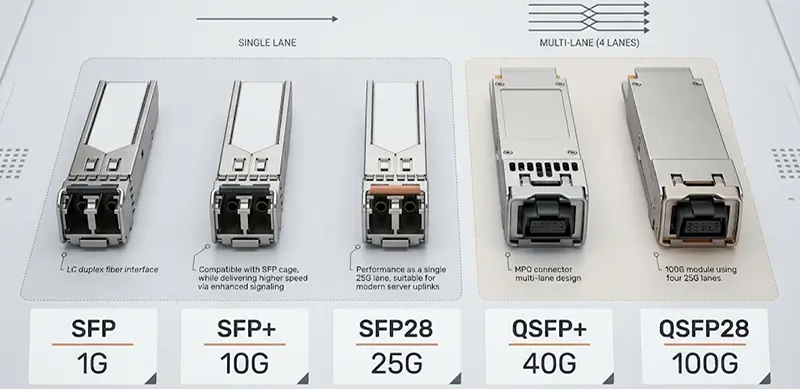
When comparing Cisco switch port types, it is also important to understand the relationship between port speed and transceiver form factor. SFP is commonly associated with 1G connectivity, while SFP+ is widely used for 10G Ethernet. SFP28 is commonly associated with 25G Ethernet. QSFP+ is frequently used for 40G, while QSFP28 is widely used for 100G applications.
These form factors allow network administrators to select the appropriate optical transceiver or cable for their deployment. The exact compatibility depends on the Cisco switch model and its supported transceiver list. For this reason, purchasing a Cisco switch based only on the advertised port speed can lead to compatibility problems. The switch model, interface type, supported optics, fiber type, and intended connection distance should all be checked before installation.
How to Choose the Right Cisco Switch Port Speed
The right port speed depends primarily on the role of the switch and the devices being connected.
For a small office with standard computers, IP phones, printers, and access points, 1G connectivity may provide sufficient performance. In a larger organization, 10G uplinks can provide the additional bandwidth required to connect access switches to the network core.
For data centers, the requirements can be considerably higher. Virtualization hosts, high-performance servers, storage systems, and large databases may benefit from 10G or 25G server connections. At the aggregation and core layers, 40G or 100G interfaces may be more appropriate.
Future growth should also be considered. Selecting a switch only for today’s requirements may result in another expensive upgrade when network traffic increases. A scalable design can make it easier to add faster uplinks and upgrade servers without replacing the entire network infrastructure.
The Importance of Cisco Switch Compatibility
Cisco networking equipment includes many generations and product families, and port compatibility can vary significantly between models. A port that looks similar physically may support different speeds, transceiver types, or configuration options.
Before purchasing a Cisco switch, it is important to verify the exact model number and determine which interfaces it provides. You should also check whether the required SFP, SFP+, SFP28, QSFP+, or QSFP28 transceiver is supported.
Compatibility is particularly important when using used or refurbished Cisco switches. The switch may be fully functional, but the required transceiver or cable may not be included, or a particular optic may not be supported by that platform.
Cisco Switch Port Speed and IT Support
Correct network design is only part of achieving reliable performance. Configuration, monitoring, troubleshooting, firmware, VLANs, spanning tree, link aggregation, and physical connectivity can all affect network performance.
Professional IT Support can help businesses identify network bottlenecks and determine whether the problem is actually related to port speed. For example, slow file transfers do not necessarily mean that a company needs 100G networking. The cause could instead be a faulty cable, incorrect duplex settings, overloaded server, poor switch configuration, packet loss, or insufficient uplink capacity.
An experienced IT Support team can evaluate the existing infrastructure, check switch interfaces, analyze traffic patterns, verify transceiver compatibility, and recommend an appropriate upgrade path.
Final Thoughts
Understanding Cisco switch port types is essential when designing, upgrading, or troubleshooting an enterprise network. 1G remains practical for many standard endpoints, while 10G provides a significant performance improvement for servers and uplinks. 25G offers an efficient solution for modern data center servers, 40G remains useful in many high-bandwidth environments, and 100G provides the capacity required by demanding core and data center networks.
The best choice is not always the fastest available port. Instead, organizations should consider current bandwidth requirements, connected devices, transceiver compatibility, cabling, switch architecture, budget, and future growth.
By selecting the appropriate Cisco switch port speed and combining it with proper network configuration and professional IT Support, businesses can build a network that is faster, more reliable, and easier to scale as their infrastructure grows.