

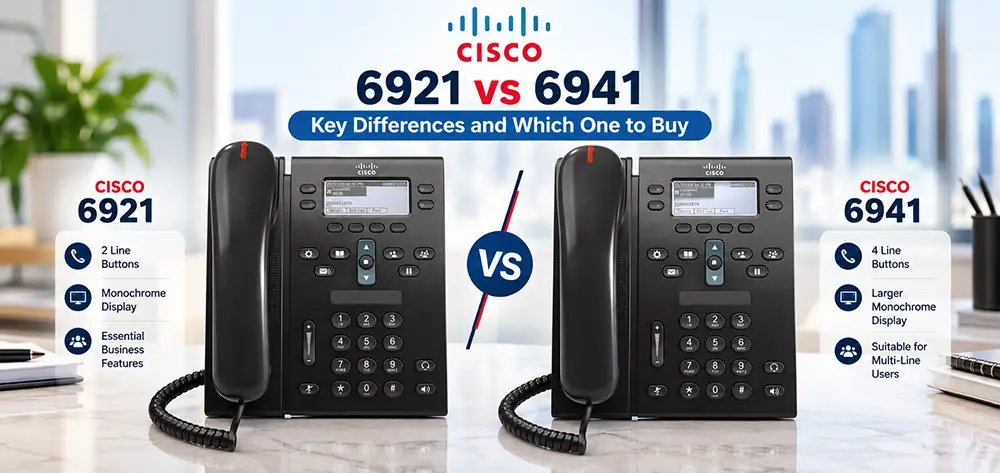
Choosing the right IP phone for your business is not simply about finding a device that can make and receive calls. Factors such as the number of supported lines, display size, network connectivity, call management features, and compatibility with your existing phone system can significantly affect daily operations. The Cisco 6921 and Cisco 6941 are two business IP phones from Cisco’s Unified 6900 Series, designed to provide reliable voice communication without the complexity of high-end enterprise phones.
Although the Cisco 6921 and Cisco 6941 share many features, they serve slightly different business requirements. The Cisco 6921 offers a straightforward two-line configuration, while the Cisco 6941 provides four line buttons and a larger display. In this comparison, we examine their technical specifications, practical differences, deployment requirements, and suitability for businesses in Dubai and across the UAE.
Overview of the Cisco 6921 IP Phone
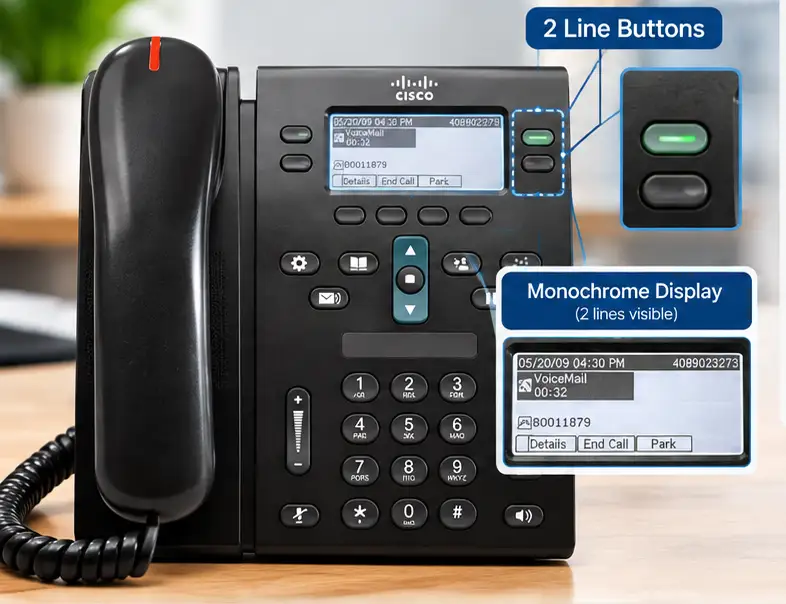
The Cisco Unified IP Phone 6921 is a compact, business-oriented desk phone designed for employees who need essential voice communication features. It supports two line appearances, a monochrome backlit LCD, a full-duplex speakerphone, and dedicated buttons for frequently used functions such as call transfer, hold, and conferencing.
Its simple interface makes it particularly suitable for administrative employees, small offices, retail businesses, and organizations deploying multiple phones across individual workstations. The Cisco 6921 also supports Power over Ethernet (PoE), allowing it to receive power and network connectivity through a compatible Ethernet connection. This reduces cable clutter and simplifies installation in offices equipped with PoE switches.
Overview of the Cisco 6941 IP Phone
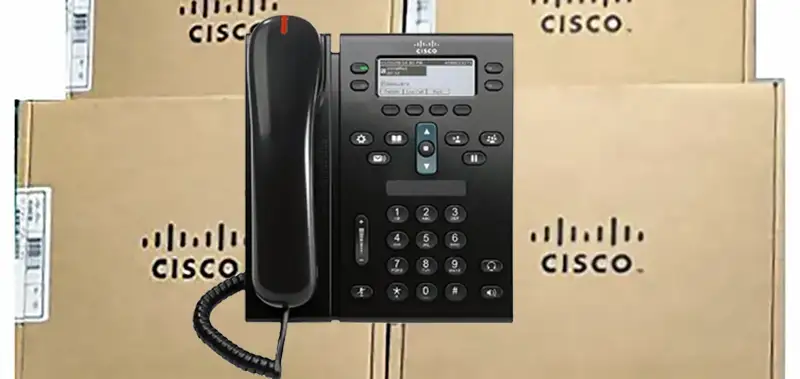
The Cisco Unified IP Phone 6941 is designed for users who require access to more telephone lines or programmable line features. It retains the familiar design and essential calling functions of the Cisco 6921 but increases the number of line buttons from two to four. Another significant improvement is its larger monochrome LCD, which provides additional screen space for call information, menus, and line labels.
The Cisco 6941 is particularly useful for receptionists, administrative assistants, office coordinators, and employees who regularly interact with multiple extensions or shared lines.
Cisco 6921 vs 6941: Technical Specifications Comparison
The following table highlights the most important hardware and functionality differences between these two Cisco IP phones.
| Specification | Cisco 6921 | Cisco 6941 |
|---|---|---|
| Product series | Cisco Unified 6900 | Cisco Unified 6900 |
| Line buttons | 2 | 4 |
| Display type | Monochrome LCD | Monochrome LCD |
| Display resolution | 396 × 81 pixels | 396 × 162 pixels |
| Backlit display | Yes | Yes |
| Ethernet ports | 2 × 10/100 Mbps | 2 × 10/100 Mbps |
| PoE support | IEEE 802.3af | IEEE 802.3af |
| Speakerphone | Full-duplex | Full-duplex |
| Headset support | Yes | Yes |
| Dedicated hold button | Yes | Yes |
| Call transfer | Yes | Yes |
| Conference calling | Yes | Yes |
| Voicemail indicator | Yes | Yes |
| SIP/SCCP firmware | Supported variants | Supported variants |
| Gigabit Ethernet | No | No |
| Touchscreen | No | No |
| Approx. dimensions | 164 × 188 × 205 mm | 164 × 188 × 205 mm |
| Recommended users | General office staff | Reception and multi-line users |
Both devices offer the core functions expected from traditional business IP phones. The primary differences concern line capacity and display size rather than basic voice quality or network performance.
1. Number of Lines: The Most Important Difference
The most significant difference in the Cisco 6921 vs 6941 comparison is the number of line buttons.
Cisco 6921: Two-Line Configuration
The Cisco 6921 provides two line buttons, making it suitable for employees who primarily use one extension but occasionally need a second line or configured feature. For example, an accounting employee may use one line for regular business calls and another for a shared departmental extension.
Two line buttons are generally sufficient for users who do not frequently manage multiple simultaneous call appearances.
Cisco 6941: Four-Line Configuration
The Cisco 6941 offers four line buttons, giving users greater flexibility when handling multiple extensions or shared lines. Consider a receptionist responsible for answering calls for sales, technical support, and management. Having additional line buttons can simplify navigation between configured lines.
However, four line buttons do not automatically mean four independent external telephone connections. The actual calling capabilities depend on how the IP PBX or Cisco call-control system is configured. Which is better? Choose the Cisco 6921 for straightforward office calling and the Cisco 6941 when additional line appearances are genuinely required.
2. Display Size and User Experience
Both models use backlit monochrome LCD screens, but the Cisco 6941 provides approximately twice the vertical display resolution. The Cisco 6921 screen displays essential information such as caller identification, call status, menus, and available soft-key functions. The larger display on the Cisco 6941 provides more room for navigating information, which can be helpful when working with several configured lines.
Neither phone offers a touchscreen or a modern color interface. Businesses requiring graphical applications or advanced visual features should consider newer Cisco IP phone families. For ordinary telephone conversations, however, the smaller display of the Cisco 6921 is generally sufficient.
3. Voice Quality and Calling Features
When comparing Cisco 6921 vs 6941, buyers sometimes assume the higher model number guarantees substantially better audio quality. In practice, both devices belong to the same product generation and offer similar fundamental voice capabilities. Both phones support full-duplex speakerphone functionality, allowing participants to speak and listen during hands-free conversations. They also provide commonly used business calling features, including:
Call hold and transfer
Conference calling
Caller identification
Call history and directory access
Voicemail notification
Headset operation
Programmable soft-key functions
Availability of individual services depends on the firmware and call-control platform. For a business whose employees mainly make and receive standard voice calls, upgrading from the Cisco 6921 to the 6941 will not necessarily produce a noticeable improvement in call quality.
4. Network Connectivity and PoE Requirements
Both the Cisco 6921 and Cisco 6941 include integrated 10/100 Mbps Ethernet connectivity. They can connect to a network switch while providing a separate Ethernet connection for a nearby computer. This configuration can be convenient in offices with limited network outlets because the phone and workstation can share a single network wall connection.
However, neither model supports Gigabit Ethernet. If a computer is connected through the phone, its wired connection is limited by the phone’s 100 Mbps network interface. For offices requiring Gigabit connectivity, connecting the computer directly to a Gigabit switch or selecting a newer IP phone with Gigabit Ethernet is preferable.
Both models support IEEE 802.3af PoE. Alternatively, compatible external power adapters can be used when PoE is unavailable. Before purchasing, verify whether the phone package includes a power adapter, as it may be sold separately.
5. Cisco Call Manager, SIP, and PBX Compatibility
Compatibility is one of the most important considerations when purchasing either phone, especially for businesses using existing Cisco voice infrastructure. The Cisco 6921 and Cisco 6941 were designed for Cisco Unified Communications environments and have documented SIP and SCCP firmware configurations.
SCCP is Cisco’s proprietary call-control protocol, while SIP is a widely used signaling protocol for VoIP communications. However, having SIP firmware does not guarantee straightforward registration with every third-party PBX.
For example, organizations using Asterisk, Issabel, FreePBX, or other SIP-based systems should verify firmware availability, provisioning requirements, and actual compatibility before purchasing. These phones are not equivalent to modern, independently configurable generic SIP phones.
Practical recommendation: If your organization already operates a compatible Cisco Unified Communications Manager environment, either model may be a cost-effective replacement or expansion device. For a new third-party PBX installation, confirm interoperability before ordering multiple units.
6. Which Cisco IP Phone Is Better for Different Businesses?
The best choice depends on how employees actually use their telephones.
| Business environment | Recommended model | Reason |
|---|---|---|
| Small office | Cisco 6921 | Essential calling functions |
| Accounting department | Cisco 6921 | Simple extension management |
| Retail store | Cisco 6921 | Basic business communication |
| Reception desk | Cisco 6941 | Additional line buttons |
| Administrative assistant | Cisco 6941 | Multiple line appearances |
| Hotel back office | Cisco 6921 | Cost-conscious deployment |
| Office with shared extensions | Cisco 6941 | Easier access to configured lines |
| Large-scale basic phone replacement | Cisco 6921 | Practical for standard users |
For companies deploying dozens of desk phones, the cost difference between models can become significant. If most employees require only one or two lines, purchasing Cisco 6941 units for every workstation may offer little operational benefit. A mixed deployment can be more economical: Cisco 6921 phones for general employees and Cisco 6941 phones for reception or administrative positions.
7. What Should You Check Before Buying Used Cisco 6921 or 6941 Phones?
Because both models are older-generation Cisco devices, buyers in the UAE should pay particular attention to their condition and compatibility. First, inspect the LCD for fading, missing pixels, or backlight problems. Check the handset, keypad, line buttons, and speakerphone.
Next, verify that the Ethernet ports function correctly and that the phone can receive power through PoE. Firmware is another critical consideration. A phone configured for a different environment may require reprovisioning before it can register with your system.
Finally, confirm the exact part number, accessories, and return conditions with the supplier. Businesses should also consider long-term maintenance. The Cisco 6900 Series is a legacy product family, so current software support, replacement availability, and compatibility with newer call-control releases must be evaluated before a new deployment.
8. Is the Cisco 6921 Still Worth Buying in 2026?
The Cisco 6921 can still be a practical purchase in 2026, particularly for organizations maintaining compatible legacy Cisco telephone systems. Its simple controls, PoE support, two-line design, and essential calling features make it suitable for replacing existing phones without investing in unnecessarily complex hardware.
However, it is not the ideal choice for every new office. Businesses requiring Gigabit Ethernet, modern security capabilities, broad third-party SIP interoperability, or long-term manufacturer support should evaluate newer alternatives. For organizations with established compatible infrastructure, the Cisco 6921 remains a reasonable option when the device is properly tested and competitively priced.
Frequently Asked Questions
1. What is the main difference between Cisco 6921 and 6941?
The Cisco 6921 has two line buttons and a smaller display, while the Cisco 6941 offers four line buttons and a larger LCD.
2. Does Cisco 6921 support PoE?
Yes. It supports IEEE 802.3af Power over Ethernet.
3. Can Cisco 6921 work without Cisco Call Manager?
It requires a compatible call-control environment. It cannot operate as a conventional standalone analog telephone.
4. Can Cisco 6941 connect to a Gigabit network?
It can connect to compatible Gigabit switches, but its own Ethernet interfaces operate at 10/100 Mbps.
5. Is Cisco 6941 better for receptionists?
Generally, yes. Its four line buttons are useful for users managing several configured extensions or shared lines.
6. Can I use Cisco 6921 with Issabel?
Compatibility depends on the firmware, provisioning method, and PBX configuration. Verify successful registration before deployment.
7. Do both phones support headsets?
Yes. Both provide headset functionality for hands-free business communication.
8. Can Cisco 6921 and 6941 work on the same phone system?
Yes, provided the call-control platform and installed firmware support both models.
Final Verdict: Cisco 6921 or Cisco 6941?
The Cisco 6921 and Cisco 6941 provide similar core calling capabilities, but their intended users differ. The Cisco 6921 is a sensible choice for standard office employees who need a dependable two-line business phone. Its straightforward interface and essential calling features make it suitable for cost-conscious deployments. The Cisco 6941 is better suited to users who benefit from four line buttons and a larger display, particularly receptionists and administrative personnel.
For businesses in Dubai and across the UAE looking for a practical telephone solution for compatible Cisco environments, the Cisco 6921 remains worth considering. At ITMan UAE, customers can explore the Cisco 6921 IP Phone for office communication and existing Cisco telephone system deployments. Confirming firmware compatibility and network requirements before purchasing will help ensure a successful installation.