






Power over Ethernet (PoE) makes network installation easier by allowing access points (APs) to receive both power and data through a single Ethernet cable. However, before installing multiple access points, it is important to calculate PoE requirements accurately. An incorrect calculation can lead to insufficient power, unstable AP operation, unexpected reboots, or an overloaded PoE switch.
Whether you are deploying a small office Wi-Fi network or a large enterprise wireless infrastructure, knowing how to calculate PoE requirements for access points helps you select the right PoE switch, power budget, and Ethernet cabling.
Why Do You Need to Calculate PoE Requirements?
Every access point has a specific power requirement. Depending on the model and features, an AP may require anywhere from around 10W to more than 30W.
When several APs are connected to the same PoE switch, their power consumption adds up. For example, if four access points require 18W each, the theoretical power requirement is:
4 × 18W = 72W
However, simply adding the AP power ratings is not always enough. You should also consider the switch’s available PoE budget, power overhead, cable losses, and the PoE standard supported by each device.
Therefore, the correct way to calculate PoE requirements is to consider both the individual AP requirements and the total available PoE power.
Step 1: Check the Access Point’s PoE Requirement
The first step to calculate PoE requirements is checking the technical specifications of the access point.
Look for information such as:
- Maximum power consumption
- Recommended PoE standard
- IEEE 802.3af, 802.3at, or 802.3bt support
- Maximum power consumption with all features enabled
- PoE input power
For example, an access point may have a maximum power consumption of 25W and require PoE+ (802.3at).
For network planning, it is generally safer to use the maximum rated power consumption rather than the average power consumption.
Common PoE Standards
| PoE Standard | Common Name | Power Available at PSE | Typical Use |
|---|---|---|---|
| IEEE 802.3af | PoE | Up to 15.4W | Basic APs, VoIP phones |
| IEEE 802.3at | PoE+ | Up to 30W | Modern APs, cameras |
| IEEE 802.3bt | PoE++ | Up to 60W or 90W | High-power APs and devices |
The exact power delivered to the powered device is lower than the maximum power supplied by the switch because some power is lost through the Ethernet cable.
Step 2: Calculate the Total AP Power
Once you know the maximum power requirement of each access point, multiply it by the number of APs.
The basic formula to calculate PoE requirements is:
Total AP Power = Number of APs × Maximum AP Power
For example, suppose you have 10 access points and each one requires a maximum of 20W:
10 × 20W = 200W
Your access points therefore require approximately 200W under maximum load.
This is the starting point for calculating the PoE budget.
Step 3: Check the PoE Switch Budget
One of the most important parts of calculating PoE requirements is checking the switch’s actual PoE power budget.
A PoE switch may have 24 or 48 PoE ports, but that does not necessarily mean it can provide maximum PoE power to every port simultaneously.
For example, a 24-port PoE switch could have:
- 24 PoE-capable ports
- 30W maximum per port
- 370W total PoE budget
Even though the theoretical port capacity is:
24 × 30W = 720W
the switch can only provide 370W in total.
Therefore, when you calculate PoE requirements, always check the switch’s total PoE power budget, not just the maximum wattage per port.
Step 4: Add a Safety Margin
It is not recommended to select a PoE switch where the calculated requirement exactly matches the available budget.
For reliable network operation, leave additional capacity for power fluctuations, future devices, and unexpected increases in consumption.
A practical calculation is:
Required PoE Budget = Total AP Power × Safety Margin
For example, if your APs require 200W and you want a 20% safety margin:
200W × 1.20 = 240W
A switch with at least 240W of usable PoE budget would be a more appropriate choice.
Using a 20–30% margin is often a reasonable approach for network planning, although the exact margin depends on the deployment.

Step 5: Consider Ethernet Cable Power Loss
When you calculate PoE requirements, remember that power travels through the Ethernet cable. Cable resistance causes some power loss between the PoE switch and the access point.
Cable length, conductor quality, cable category, temperature, and installation conditions can affect power delivery.
For standard installations using good-quality Cat5e, Cat6, or better cabling and normal cable lengths, the PoE standards account for expected cable losses.
However, long cable runs and high-power devices require more careful planning.
For example, an AP that needs approximately 25W at the device cannot simply be treated as a 25W load at the switch in every situation. The switch needs to provide enough power to compensate for the expected cable loss.
Calculate PoE Requirements: A Practical Example
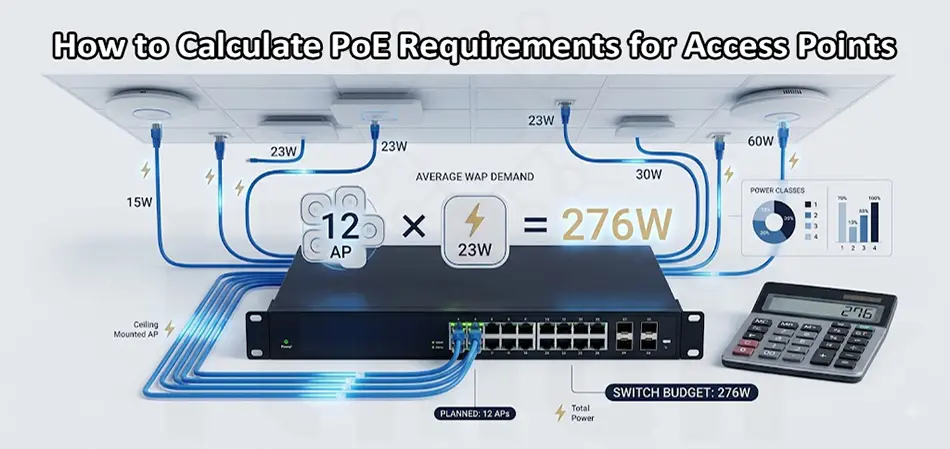
Suppose you are installing 12 Wi-Fi access points, and each AP has a maximum power consumption of 23W.
First, calculate the total AP power:
12 × 23W = 276W
Now add a 20% safety margin:
276W × 1.20 = 331.2W
Therefore, your network should have approximately 331W or more of usable PoE capacity.
If you are choosing between two switches:
- Switch A: 250W PoE budget
- Switch B: 370W PoE budget
Switch A would not provide enough capacity for this deployment, while Switch B would provide a suitable margin.
This example shows why you should calculate PoE requirements before choosing a PoE switch.
PoE Requirements for Multiple Access Point Models
Not all access points consume the same amount of power. A network may contain different AP models with different PoE requirements.
For example:
| Access Point | Quantity | Max Power | Total |
| AP Model A | 6 | 15W | 90W |
| AP Model B | 4 | 25W | 100W |
| AP Model C | 2 | 35W | 70W |
| Total | 12 | — | 260W |
The total maximum requirement is:
90W + 100W + 70W = 260W
Adding a 20% margin:
260W × 1.20 = 312W
In this scenario, you should look for a PoE switch with at least 312W of usable PoE budget.
PoE+ vs PoE++ for Access Points
The PoE standard is another important factor when you calculate PoE requirements.
Basic wireless access points may work with 802.3af PoE. More advanced Wi-Fi 6 and Wi-Fi 7 access points may require 802.3at PoE+ or, in some cases, 802.3bt PoE++.
High-performance APs can require additional power when features such as multiple radios, USB ports, additional Ethernet interfaces, or advanced radio capabilities are enabled.
For this reason, do not select a PoE switch based only on the AP’s physical Ethernet speed. A 2.5GbE or 5GbE access point may also have higher power requirements.
Always verify the manufacturer’s recommended PoE standard before purchasing the switch.
How Many Access Points Can a PoE Switch Support?
To estimate how many APs a switch can support, divide the usable PoE budget by the maximum power requirement of one AP.
Maximum APs = Usable PoE Budget ÷ AP Power Requirement
For example, a switch with a 370W PoE budget and APs requiring 20W each theoretically supports:
370 ÷ 20 = 18.5
So, the switch could theoretically power 18 APs at 20W each.
However, this calculation should not be used without considering a safety margin. For a production network, it is better to keep some PoE capacity available rather than operate the switch continuously at its maximum budget.
Common Mistakes When Calculating PoE Requirements
Several mistakes can cause problems when you calculate PoE requirements for access points.
- Using Average Power Instead of Maximum Power: An AP may normally consume 12W but require 20W under maximum load. Using 12W for your calculation can result in an undersized PoE budget.
- Ignoring the Switch’s Total PoE Budget: A switch may support 30W per port but have a much smaller total power budget. Always check both values.
- Forgetting Other PoE Devices: If the same switch powers IP phones, CCTV cameras, wireless controllers, or other PoE devices, their consumption must be included.
- Not Planning for Future APs: If you expect to add more access points later, reserve additional PoE capacity now or select a switch with a larger power budget.
- Choosing the Wrong PoE Standard: A high-power AP may not operate correctly when connected to a switch that only supports a lower PoE standard.
Final Formula to Calculate PoE Requirements
For a straightforward deployment, you can use this formula:
Required PoE Budget = (Number of APs × Maximum AP Power) × Safety Margin
For example:
(15 APs × 22W) × 1.20 = 396W
Therefore, the deployment should have approximately 396W or more of usable PoE capacity.
For larger enterprise networks, also consider cable length, other PoE devices, switch power allocation, environmental conditions, and future expansion.
Final Tips for Calculating PoE Requirements
Before purchasing a PoE switch for wireless access points, check these items:
- Identify the maximum power consumption of every AP.
- Determine whether the AP requires 802.3af, 802.3at, or 802.3bt.
- Multiply AP quantity by maximum power consumption.
- Include all other PoE devices connected to the switch.
- Add a reasonable safety margin.
- Check the switch’s total PoE budget.
- Consider cable length and installation conditions.
- Leave additional capacity for future access points.
Accurately learning how to calculate PoE requirements allows you to select the right PoE switch without overspending or creating a power shortage. For small offices and large enterprise deployments alike, calculating the total PoE budget before installation is an essential part of reliable network design.