






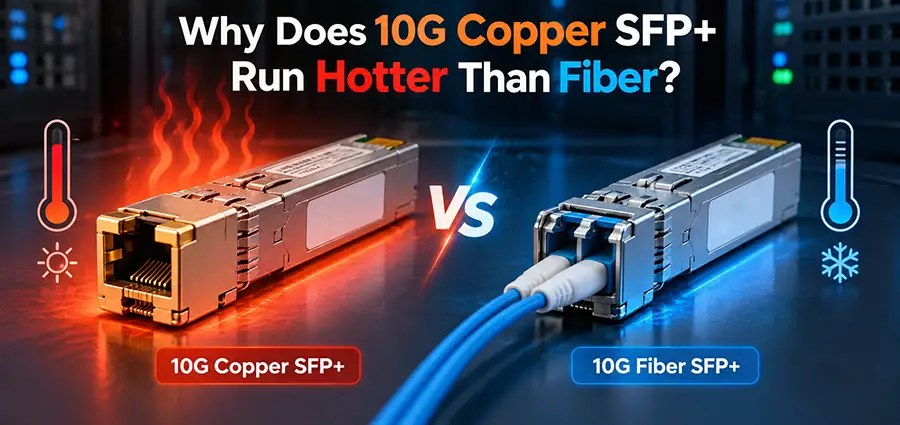
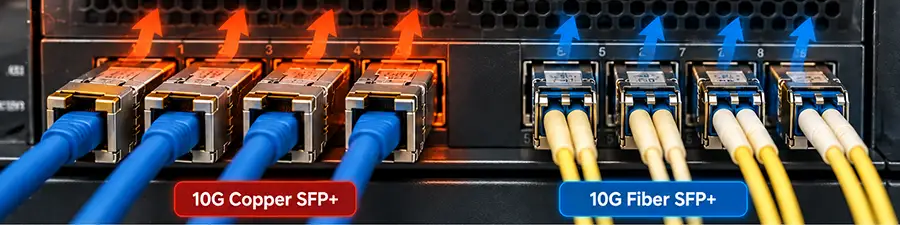
When building or upgrading a 10 Gigabit Ethernet network, SFP+ modules provide a flexible way to connect switches, servers, routers, and other network equipment. Depending on the infrastructure, a 10G connection may use fiber optic transceivers such as 10GBASE-SR or 10GBASE-LR, or a copper RJ45 SFP+ module designed for 10GBASE-T connections. Although both solutions can provide 10Gbps Ethernet connectivity, there is one noticeable difference between them: 10G copper SFP+ modules usually operate at significantly higher temperatures than fiber SFP+ transceivers.
This often surprises network administrators. A small RJ45 transceiver may become hot enough that touching it after extended operation feels uncomfortable, while a neighboring fiber SFP+ module remains considerably cooler. In most cases, this does not automatically indicate a defective transceiver. The difference is mainly caused by the amount of signal processing, power consumption, and electrical circuitry required to transmit 10Gbps Ethernet over twisted-pair copper cabling.
Understanding why this happens is important when designing high-density switches, selecting transceivers, troubleshooting unstable 10G links, or installing multiple copper SFP+ modules in the same network device.
How Does a 10G Copper SFP+ Module Work?
A 10G copper SFP+ module converts the electrical interface of an SFP+ port into a standard RJ45 Ethernet connection. This allows a switch with SFP+ slots to connect directly to equipment using conventional twisted-pair Ethernet ports. For example, a server with a 10GBASE-T network adapter may be connected to an SFP+ switch using Cat6a cabling and an RJ45 10G copper SFP+ transceiver.
This sounds like a simple conversion, but 10GBASE-T is technically demanding. Unlike a fiber transceiver that primarily converts electrical signals into optical signals and back again, a 10GBASE-T module must perform sophisticated digital signal processing to transmit 10Gbps reliably over copper pairs.
Inside the compact SFP+ housing, the module may need to handle functions such as:
- Signal encoding and decoding
- Echo cancellation
- Crosstalk cancellation
- Equalization
- Error correction
- Signal amplification
- PHY processing
- Electrical-to-interface conversion
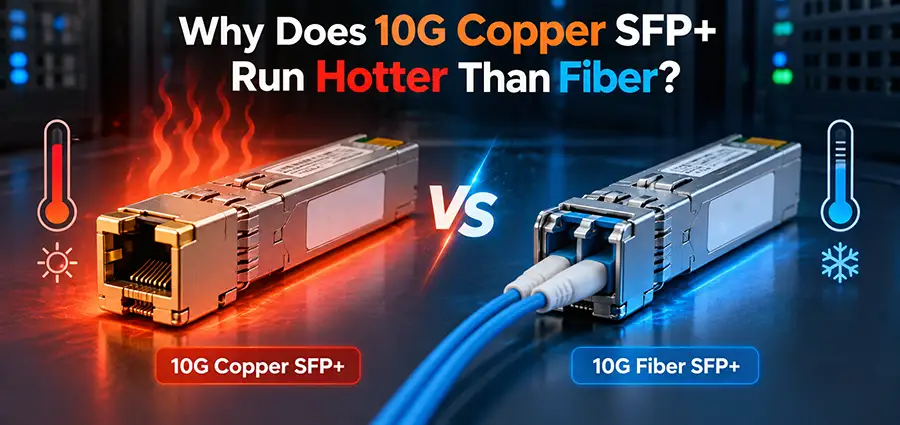
All these operations consume electrical power. Most of that consumed power eventually becomes heat. This is the fundamental reason 10G copper SFP+ modules run hotter than fiber SFP+ modules.
Why Does 10G Copper SFP+ Generate More Heat?
The primary factor is power consumption. Fiber optic SFP+ modules are generally very efficient. A typical 10G optical transceiver consumes relatively little power because optical transmission does not require the same complex electrical compensation needed for high-speed copper Ethernet.
A 10GBASE-T SFP+ module contains considerably more active electronics. Copper cables are affected by electrical characteristics such as attenuation, electromagnetic interference, return loss, and crosstalk. Maintaining a reliable 10Gbps connection over twisted-pair cabling therefore requires advanced processing inside the transceiver.
More processing requires more power. More power produces more heat. The physical dimensions of the SFP+ form factor make the issue even more noticeable. There is very little surface area available for dissipating heat, so a few watts of power concentrated inside such a small metal enclosure can result in a relatively high operating temperature.
10G Copper SFP+ vs Fiber SFP+: Power Consumption
Power consumption varies between manufacturers and module generations, so there is no single value that applies to every transceiver.
However, the general difference is clear.
| Transceiver Type | Typical Relative Power Use | Heat Generation |
|---|---|---|
| 10GBASE-SR SFP+ | Low | Low |
| 10GBASE-LR SFP+ | Low to moderate | Low to moderate |
| SFP+ DAC | Very low | Very low |
| 10GBASE-T SFP+ RJ45 | High | High |
Modern 10GBASE-T modules have become more efficient than earlier generations, but they can still consume substantially more power than common optical SFP+ modules.
The difference becomes particularly important when several copper modules are installed next to each other. One hot module may not create a serious thermal problem. Eight, sixteen, or more high-power RJ45 SFP+ modules concentrated in the same area can create a much larger thermal load.
Why Does 10GBASE-T Require So Much Signal Processing?
Sending 10Gbps over copper is significantly more difficult than sending 1Gbps Ethernet. 10GBASE-T uses all four twisted pairs simultaneously and relies on sophisticated modulation and digital signal processing techniques to achieve its data rate.
The transceiver must continuously compensate for signal degradation. One major challenge is crosstalk. Electrical signals traveling through adjacent copper pairs can interfere with each other. At higher frequencies, managing this interference becomes increasingly difficult.
The PHY must therefore perform real-time signal correction. Another challenge is attenuation. As cable length increases, the electrical signal becomes weaker. The receiver must recover usable data from this degraded signal.
These operations happen continuously while the link is active. A fiber optic transceiver faces different engineering challenges, but optical fiber is naturally resistant to electromagnetic interference and does not require the same type of copper-line signal compensation.
This contributes to the lower power requirements of many optical SFP+ modules.
Why Does the Small SFP+ Form Factor Make Heat Worse?
The SFP+ form factor was originally designed around relatively low-power transceivers. A copper 10GBASE-T PHY puts considerably more electronics into essentially the same compact space. This creates a high power density.
Imagine two electronic devices consuming different amounts of power but occupying almost the same physical volume. The higher-power device generally has more thermal energy to remove. The metal enclosure of an SFP+ module helps transfer heat away from the internal components, but the heat still has to move somewhere. Normally it is transferred into:
- The SFP+ cage
- The switch chassis
- Surrounding airflow
- Adjacent components
This is why proper switch ventilation becomes particularly important when using multiple 10G copper modules.
Is It Normal for a 10G Copper SFP+ Module to Feel Very Hot?
Yes, a noticeably hot RJ45 SFP+ module can be normal. The external metal casing acts partly as a heat spreader. Therefore, feeling heat on the outside of the module may actually indicate that thermal energy is being transferred away from its internal electronics.
However, there is a difference between normal operating heat and excessive temperature. Temperature becomes more concerning when accompanied by symptoms such as:
- Intermittent link drops
- Port resets
- Reduced link speed
- Packet errors
- Transceiver warnings
- Switch temperature alarms
- Unexpected module shutdowns
If the connection remains stable and the module operates within its specified temperature range, a warm or hot enclosure alone does not necessarily mean the module is faulty.
Can High Temperature Cause 10G Network Problems?
Potentially, yes. Electronic components have defined operating temperature limits. If a transceiver exceeds those limits, stability can deteriorate. Excessive temperature can contribute to intermittent connectivity, PHY errors, unexpected link negotiation problems, or shortened component life.
The risk becomes greater when several heat-producing modules are installed together. For example, placing multiple RJ45 SFP+ transceivers in adjacent ports may create localized heat around the SFP+ cage. If airflow is poor, each module is affected by the heat produced by neighboring modules.
The switch itself also generates heat from its switching ASIC, CPU, power supplies, PoE circuitry, and other internal components. The result can be a thermal hotspot around the uplink ports.
Does Cable Length Affect 10G Copper SFP+ Temperature?
It can. Longer copper links generally require more demanding signal processing than very short connections. Depending on the design of the PHY and transceiver, power consumption and thermal behavior may therefore vary with link conditions. Another important limitation is that not every 10GBASE-T SFP+ module supports the same maximum distance.
Some RJ45 SFP+ modules are designed primarily for shorter connections, while others may support longer 10GBASE-T distances under appropriate cabling conditions. Always verify the manufacturer’s supported distance rather than assuming every RJ45 SFP+ transceiver can provide 10Gbps over 100 meters. Cable quality also matters.
For reliable 10G Ethernet, Cat6a is generally the preferred choice for full-distance structured cabling. Poor-quality cabling, bad terminations, excessive interference, or unsuitable cable categories can make an already demanding electrical link less reliable.
Why Are Fiber SFP+ Modules Usually Cooler?
Fiber transmission avoids many of the electrical problems associated with high-speed twisted-pair copper. A typical optical SFP+ transceiver includes a laser transmitter, optical receiver, monitoring circuitry, and electrical interface. It still produces heat, but many common 10G optical modules require less power than 10GBASE-T RJ45 transceivers. Fiber also provides several other advantages for 10G networking.
It can support much longer distances, offers electrical isolation, and is resistant to electromagnetic interference. For example, 10GBASE-SR is commonly used for shorter multimode fiber connections, while 10GBASE-LR is designed for longer single-mode fiber links.
When switches already have SFP+ ports at both ends, using optical transceivers may therefore provide a more thermally efficient solution than converting those ports to RJ45.
10G Copper SFP+ vs Fiber SFP+: Practical Comparison
| Feature | 10G Copper SFP+ | Fiber SFP+ |
|---|---|---|
| Connector | RJ45 | LC typically |
| Medium | Twisted-pair copper | Optical fiber |
| Heat generation | Higher | Lower |
| Power consumption | Higher | Lower |
| EMI resistance | Lower | Very high |
| Typical distance | Short to moderate | Short to very long depending on optic |
| Existing RJ45 compatibility | Excellent | Requires fiber interface |
| Signal processing complexity | High | Generally lower |
| High-density deployment | More thermally challenging | Better suited thermally |
Neither technology is automatically the correct choice for every network. Copper is extremely useful when the existing infrastructure uses RJ45 ports and twisted-pair cabling. Fiber is often more appropriate for switch uplinks, longer connections, electrically noisy environments, and high-density 10G deployments.
What Happens When Multiple Copper SFP+ Modules Are Installed Together?
This is where thermal management becomes particularly important. Installing one 10GBASE-T module in a switch with strong airflow may cause no problems at all. Filling many adjacent SFP+ ports with copper modules is different. Each module generates heat, and neighboring modules reduce the amount of cool air surrounding each transceiver.
The total power drawn from the SFP+ ports also increases. Some network equipment manufacturers therefore place restrictions on the number or location of high-power transceivers that can be installed simultaneously.
In certain devices, manufacturers may recommend leaving spaces between copper modules or limiting specific module types in high-temperature environments. Before deploying many RJ45 SFP+ modules, check the switch’s transceiver compatibility information and thermal requirements.
How to Reduce 10G Copper SFP+ Temperature
The first step is ensuring unrestricted airflow around the network equipment. Do not block the switch’s intake or exhaust vents. Keep the device in an environment that stays within its specified ambient operating temperature. Avoid placing high-heat networking equipment in poorly ventilated cabinets.
For high-density deployments, also consider whether every connection actually needs an RJ45 SFP+ transceiver. If two devices already provide native SFP+ interfaces, a DAC cable may be more efficient for short rack-level connections. Fiber may be preferable for longer links.
Another practical approach is to avoid unnecessarily grouping many high-power copper modules together when the equipment manufacturer provides alternative port-placement recommendations.
Most importantly, use compatible modules from reputable manufacturers. Thermal design, PHY efficiency, firmware compatibility, and power consumption can differ substantially between transceivers.
Copper SFP+, Fiber, or DAC: Which Makes More Sense?
The answer depends on the connection. For very short switch-to-server or switch-to-switch links within the same rack, SFP+ DAC cables can be an excellent option. They generally consume very little power, have low latency, and do not require separate optical transceivers.
For longer connections between switches, racks, or buildings, fiber SFP+ modules are often the better solution. A 10G copper SFP+ module makes the most sense when one side of the connection uses an SFP+ interface while the other side provides a 10GBASE-T RJ45 port, or when existing copper cabling must be reused.
Using RJ45 SFP+ modules simply because copper feels more familiar is not always the most efficient design.
Is a Hot Copper SFP+ Module Defective?
Not necessarily. Heat is an expected characteristic of 10GBASE-T SFP+ technology because of its relatively high power consumption and complex PHY circuitry. A module should be investigated when high temperature is accompanied by actual performance problems or when monitoring shows that it is operating outside the manufacturer’s specified limits.
If a module repeatedly loses its link, generates errors, causes temperature alarms, or behaves differently from identical modules operating under the same conditions, troubleshooting is justified. The module, cable, port, compatibility, firmware, and airflow should all be considered rather than assuming temperature alone proves a hardware failure.
Final Thoughts
The reason 10G copper SFP+ runs hotter than fiber SFP+ comes down primarily to electrical complexity and power density. 10GBASE-T requires substantial real-time signal processing to move 10Gbps across twisted-pair copper. Echo cancellation, equalization, crosstalk management, and other PHY functions require power, and that power ultimately becomes heat inside a very small transceiver.
Fiber SFP+ modules generally require less electrical processing and therefore tend to consume less power and operate cooler. DAC cables can reduce power requirements even further for short-distance SFP+ connections.
For a small number of copper transceivers, the additional heat is usually manageable in compatible networking equipment with proper airflow. In high-density deployments, however, thermal load should become part of the network design.
A hot 10G copper SFP+ module is therefore not automatically a bad module. In many cases, it is simply a normal consequence of putting a relatively power-hungry 10GBASE-T PHY inside the compact SFP+ form factor.