












 ? Message us on
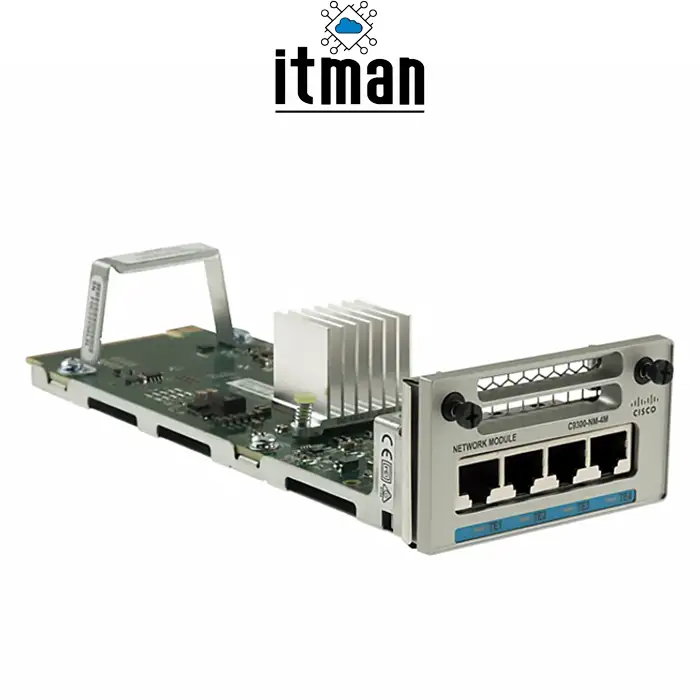
 The Cisco C9300-NM-4M Network Module is a high-performance Multigigabit uplink module developed for Cisco Catalyst 9300 Series switches. It provides four copper Multigigabit Ethernet interfaces, giving enterprise networks a flexible way to establish high-speed uplinks without relying on fiber transceivers. With support for multiple Ethernet speeds up to 10 Gigabit Ethernet, the module is particularly useful in environments where existing copper cabling must support increasing bandwidth requirements. For businesses upgrading their network infrastructure while maintaining the flexibility of RJ45 copper connectivity, the Cisco C9300-NM-4M provides a practical and scalable solution.
Cisco C9300-NM-4M Network Module
Designed specifically for the modular uplink architecture of the Catalyst 9300 platform, the Cisco C9300-NM-4M expands the connectivity options available at the rear of compatible switches. Instead of providing SFP or SFP+ cages, this module features four Multigigabit copper interfaces capable of operating at 100 Mbps, 1 Gbps, 2.5 Gbps, 5 Gbps, or 10 Gbps depending on the connected equipment, cabling, and configuration. This makes the module particularly versatile for connecting switches, servers, network appliances, distribution equipment, and other high-bandwidth devices. The C9300-NM-4M is available from ITMan for organizations looking to expand or upgrade their Cisco Catalyst 9300 infrastructure.
Cisco C9300-NM-4M Processing Architecture
The Cisco C9300-NM-4M does not contain a standalone general-purpose processor like a complete network switch or router. Instead, it operates as an expansion network module and relies on the processing architecture of the host Cisco Catalyst 9300 switch. Traffic entering or leaving through the module is processed as part of the Catalyst 9300 switching architecture.
This design allows the Cisco C9300-NM-4M ports to integrate directly with the capabilities of the host switch. Cisco states that network-module ports operate at line rate and support the software features available on the switch’s regular network interfaces. Therefore, the actual switching, forwarding, security, QoS, and management capabilities depend primarily on the Catalyst 9300 model, software release, and configuration in which the module is installed.
RAM and Memory
The Cisco C9300-NM-4M does not have user-accessible or independently configurable RAM. Memory resources required for network operation are provided by the host Catalyst 9300 switch.
This distinction is important when evaluating the specifications of the module. RAM capacity should not be listed as an independent specification of the C9300-NM-4M because the module functions as an uplink expansion component rather than a standalone computing platform. Network administrators should therefore consider the memory specifications of their specific Catalyst 9300 switch when evaluating the overall platform.
Storage and Hard Drive
There is no internal hard drive, SSD, or dedicated storage device inside the Cisco C9300-NM-4M. The module does not need local storage because it does not independently store Cisco IOS XE, configuration files, logs, or network applications.
Configuration and software are handled by the host Catalyst 9300 switch. Certain Catalyst 9300 configurations can support separate storage options, but these belong to the Cisco switch platform and should not be confused with the C9300-NM-4M itself.
Design, Build Quality and Form Factor
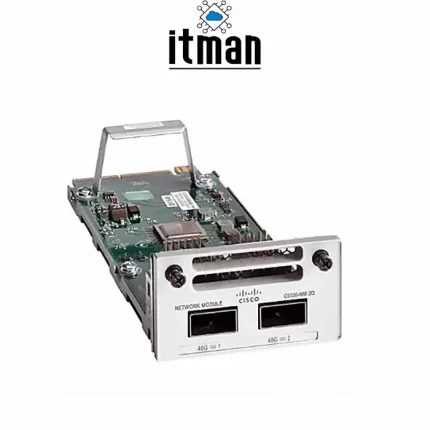
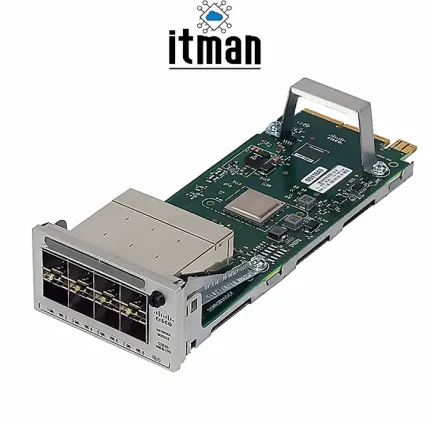
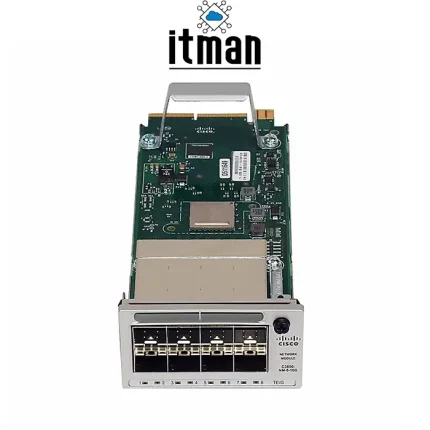
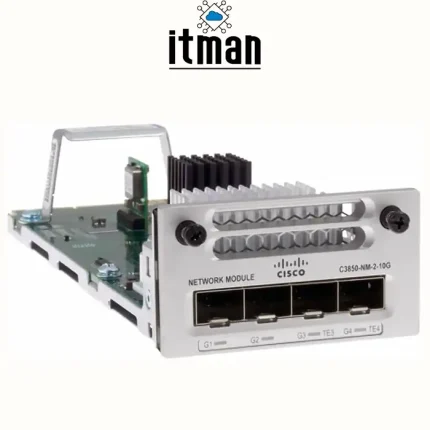
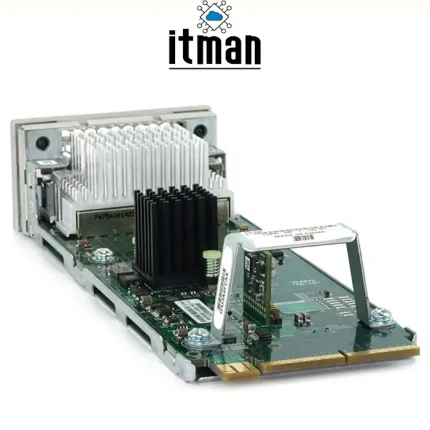
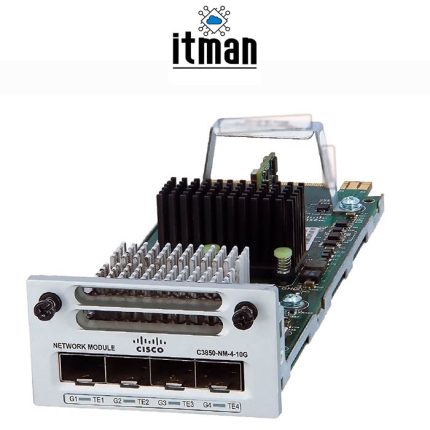
The Cisco C9300-NM-4M follows the compact modular design used by Cisco for Catalyst 9300 network modules. It is engineered to fit directly into the dedicated network-module slot of supported Catalyst 9300 Series switches.
The metal enclosure provides the durability expected from enterprise networking hardware and protects the internal electronics during continuous operation in server rooms and network racks. The front section provides four clearly arranged copper Ethernet interfaces, allowing technicians to connect and manage uplink cables without requiring external transceiver modules.
Because the C9300-NM-4M is designed specifically for the Catalyst 9300 modular architecture, it integrates cleanly with the switch rather than operating as an external adapter. This helps maintain an organized rack installation while providing additional high-speed connectivity.
Cisco C9300-NM-4M Ports and Network Speeds
The defining feature of the Cisco C9300-NM-4M is its four Multigigabit copper Ethernet ports. Unlike the C9300-NM-8X, which uses SFP/SFP+ interfaces, or the C9300-NM-2Y, which uses SFP28 interfaces, the C9300-NM-4M is designed for copper Ethernet connections.
Each interface can support multiple Ethernet speeds, including:
- 100 Mbps
- 1 Gbps
- 2.5 Gbps
- 5 Gbps
- 10 Gbps
This multi-speed capability allows the module to communicate with equipment that does not necessarily operate at 10GbE. It can therefore be used in mixed-speed environments and upgraded progressively as the rest of the infrastructure evolves.
Applications of the Cisco C9300-NM-4M
The Cisco C9300-NM-4M is suitable for enterprise networks that require high-speed copper uplinks from a Catalyst 9300 switch. A common application is connecting an access-layer Catalyst 9300 to another switch or network device over copper where fiber is unnecessary or unavailable.
It can also be useful for connecting high-performance servers, appliances, storage-related network equipment, or other devices equipped with Multigigabit or 10GBASE-T Ethernet interfaces.
Another important application is infrastructure modernization. An organization may have equipment operating at different speeds such as 1G, 2.5G, 5G, and 10G. Instead of selecting an uplink module limited to one specific copper speed, the Cisco C9300-NM-4M provides considerably greater flexibility.
Why Choose a Multigigabit Copper Network Module?
Fiber uplinks are extremely common in enterprise networks, but fiber is not always necessary. Short-distance connections inside a server room, equipment room, or rack environment can often be handled efficiently with copper Ethernet.
The Cisco C9300-NM-4M is particularly valuable when the connected equipment already provides RJ45 Ethernet interfaces. In such situations, using a copper Multigigabit module can eliminate the need for separate optical transceivers and fiber patch cables.
The ability to negotiate different link speeds also simplifies migrations. Existing 1G equipment can remain connected while newer 2.5G, 5G, or 10G equipment is introduced.
Cisco C9300-NM-4M for Network Upgrades
One of the major advantages of modular switches is the ability to change uplink connectivity without replacing the entire switch. The Cisco C9300-NM-4M makes this possible for organizations that need Multigigabit copper connectivity.
For example, a Catalyst 9300 deployment originally designed around Gigabit Ethernet may later need faster connectivity to upstream devices. Installing an appropriate network module can provide the required interface type while preserving the existing switch infrastructure.
This makes the C9300-NM-4M useful in network refresh projects, office infrastructure upgrades, campus networks, enterprise access layers, server rooms, and other environments where bandwidth requirements increase over time.
Cisco C9300-NM-4M vs Other Cisco Catalyst 9300 Network Modules
Cisco offers several network modules for the Catalyst 9300 family. The primary difference between them is the number, connector type, and maximum speed of their interfaces.
| Feature | C9300-NM-4M | C9300-NM-4G | C9300-NM-8X | C9300-NM-2Y |
|---|---|---|---|---|
| Number of Ports | 4 | 4 | 8 | 2 |
| Interface Type | Copper Multigigabit | SFP | SFP/SFP+ | SFP28 |
| Maximum Port Speed | 10 Gbps | 1 Gbps | 10 Gbps | 25 Gbps |
| 1G Support | Yes | Yes | Yes | Yes |
| 2.5G Support | Yes | No | No | No |
| 5G Support | Yes | No | No | No |
| 10G Support | Yes | No | Yes | Yes |
| 25G Support | No | No | No | Yes |
| Copper RJ45 Connectivity | Yes | No | No | No |
| Optical Transceiver Required | No for copper Ethernet | Yes | Yes | Yes |
| Primary Use | Multigigabit copper uplinks | 1G fiber uplinks | 1G/10G fiber uplinks | High-speed 1G/10G/25G fiber uplinks |
The Cisco C9300-NM-4M is therefore fundamentally different from the fiber-oriented modules in the Catalyst 9300 family. Its main advantage is flexible Multigigabit copper connectivity rather than optical connectivity or maximum fiber bandwidth.
Technical Specifications of Cisco C9300-NM-4M
| Specification | Cisco C9300-NM-4M |
|---|---|
| Manufacturer | Cisco |
| Product Series | Catalyst 9300 |
| Model | C9300-NM-4M |
| Product Type | Network / Uplink Module |
| Number of Interfaces | 4 |
| Interface Technology | Multigigabit Ethernet |
| Media Type | Copper |
| Connector Type | RJ45 |
| Supported Speeds | 100M / 1G / 2.5G / 5G / 10G |
| Maximum Speed per Port | 10 Gbps |
| 1 Gigabit Ethernet | Supported |
| 2.5 Gigabit Ethernet | Supported |
| 5 Gigabit Ethernet | Supported |
| 10 Gigabit Ethernet | Supported |
| SFP Slots | No |
| SFP+ Slots | No |
| SFP28 Slots | No |
| QSFP+ Slots | No |
| Standalone CPU | No |
| Dedicated User RAM | No |
| Internal HDD/SSD | No |
| Installation Type | Modular |
| Host Platform | Cisco Catalyst 9300 Series |
| Primary Application | High-speed copper uplinks |
| Enterprise Use | Yes |
| Line-Rate Ports | Yes |
| Replaceable Network Module | Yes |
| Management | Through host Catalyst 9300 switch |
FAQ About Cisco C9300-NM-4M
1. What is the Cisco C9300-NM-4M?
The Cisco C9300-NM-4M is a four-port Multigigabit copper network module designed for supported Cisco Catalyst 9300 Series switches.
2. Is the C9300-NM-4M an SFP module?
No. The C9300-NM-4M does not provide SFP or SFP+ cages. It uses copper Multigigabit Ethernet interfaces.
3. How many ports does the Cisco C9300-NM-4M have?
It provides four Multigigabit Ethernet ports.
4. Does the C9300-NM-4M support 10GbE?
Yes. Its Multigigabit interfaces can operate at speeds up to 10 Gbps.
5. Does the Cisco C9300-NM-4M support 2.5GbE?
Yes. 2.5 Gigabit Ethernet is one of the supported Multigigabit speeds.
6. Can the C9300-NM-4M operate at 5GbE?
Yes. The module supports 5 Gigabit Ethernet connectivity in addition to other supported Ethernet speeds.
7. Does the C9300-NM-4M require SFP+ transceivers?
No. It is a copper Multigigabit module and does not require SFP+ optical transceivers for its RJ45 Ethernet connections.
8. What is the difference between C9300-NM-4M and C9300-NM-8X?
The C9300-NM-4M provides four Multigigabit copper interfaces, while the C9300-NM-8X provides eight 1G/10G SFP/SFP+ interfaces. The correct choice depends primarily on whether copper or fiber connectivity is required.
9. What is the difference between C9300-NM-4M and C9300-NM-4G?
The C9300-NM-4M provides four Multigigabit copper interfaces supporting speeds up to 10GbE, whereas the C9300-NM-4G provides four 1GbE SFP slots.
10. Does the Cisco C9300-NM-4M have its own RAM or CPU?
No. It is a network expansion module and relies on the host Catalyst 9300 switch for system processing and memory resources.
Conclusion
The Cisco C9300-NM-4M Network Module is an excellent expansion option for Catalyst 9300 environments that require flexible, high-speed copper connectivity. Its four Multigigabit interfaces support 100M, 1G, 2.5G, 5G, and 10G Ethernet, allowing a single module to accommodate equipment operating at several different network speeds.
Unlike fiber-focused Catalyst 9300 modules, the Cisco C9300-NM-4M is designed around copper Ethernet connectivity, making it particularly useful for short-distance high-bandwidth connections, server rooms, enterprise access networks, switch-to-switch links, and infrastructure upgrades. Its modular architecture also allows organizations to expand network capabilities without replacing the complete Catalyst 9300 switch.
For businesses looking for the Cisco C9300-NM-4M for an existing or planned Catalyst 9300 deployment, ITMan supplies Cisco networking equipment and can help customers select the appropriate module based on their required interface type and network speed.






















Reviews
There are no reviews yet.